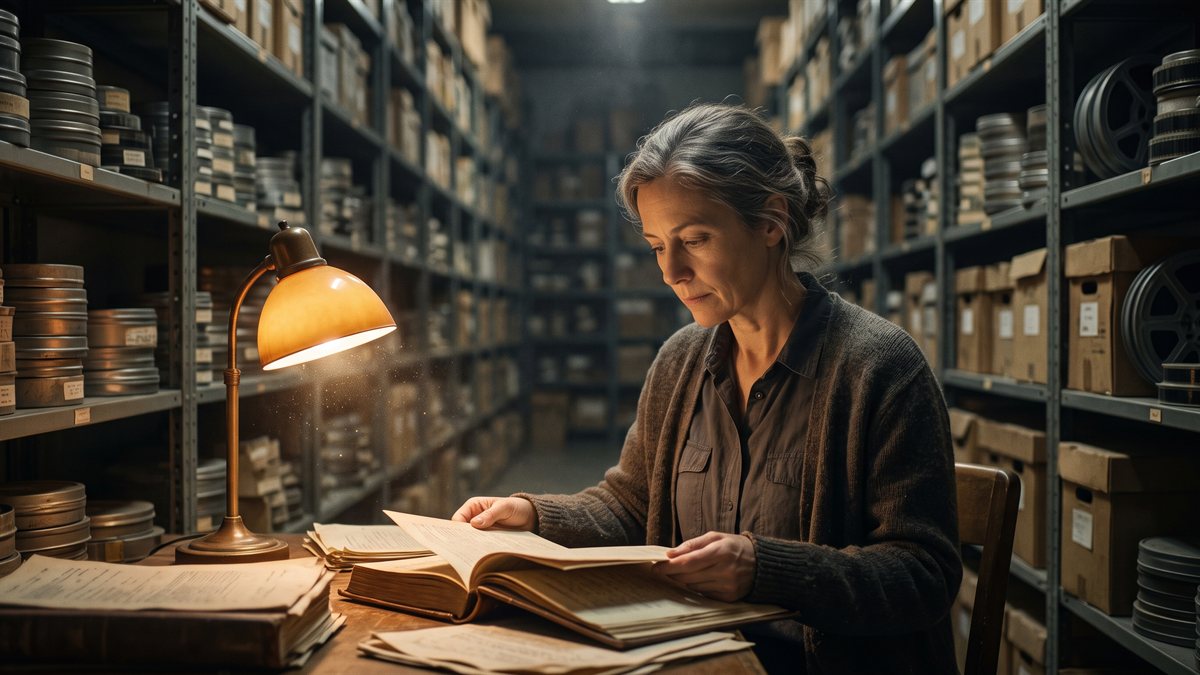
Sen Lovax, Senior Archivist (Human, plural)
- Time
- 2831 UCSD, Late Autumn, Fifty-Three Days After Dock Seven
- Location
- Threshold Station, the High Captain's office and the Survey Archive
Inquiry documents were copied to the Survey Archive for filing, which was how the submission reached the reconciling desk, and the desk did what it did with everything: it checked.
Cael went first, because Cael always went first. Union land register, Boirinn Uplands, entry current. Holding recorded under the name Shepherd for six generations. Item sixteen, general flora anomaly, older than her enlistment, never flagged for follow-up until the Line Captain flagged it. The flag: four lines, grounds cited as phase-lag consistency with item fourteen. Every citation in the submission checks. A pause, of the kind Sen had learned to wait through. It is tidy.
Tidy was the word Cael used for the things it trusted least. A record that closed cleanly was what a closed file looked like from outside, and Cael had reopened enough of them to know the shape. But there was nothing here to reopen. Nothing in the submission was false. It was, Cael conceded, with the reluctance of somebody handing over a finding they had hoped to keep, entirely accurate.
Accurate, Wyn said, and who is it for?
That was Wyn's question and Wyn asked it of everything the desk touched — who was protected by this closure, and who paid. Sen let the question run, because it was the desk's other half and had been for eleven years.
A family kept a rule for six generations about not being looked at, Wyn said. The Union keeps a version of the same rule itself — a Highland Guard detail on any Ranger on leave, from the moment she is met, whose planet it still is. The family kept theirs through the landings and the charter and a daughter going to Eden in a uniform. It is now in an inquiry file, under a heading, with a register reference. That is who paid. And the person whose name is on the heading is not here to be asked whether she minds.
She would not have answered it either, Sen said.
That is not the same as it not costing her.
No, Sen said. It isn't.
Sen fronted, and held the desk, and decided what the desk would do, which was the part the other two left to Sen because somebody had to sign the timesheet.
The desk's work was reconciliation. It read what a station had filed against what the station's own instruments had logged, and where the two disagreed it added a note, unsigned, at the bottom, naming the gap and — Wyn's contribution — the cost of the silence that had let the gap stand. That was the whole of the job and Sen had never once been asked to do more of it. Eleven years of notes, and not one of them had ever argued. They put two things next to each other and let the adjacency do it.
Here nothing disagreed. The instruments said what the log said. The log said what the flag said. The submission did not sit in a gap between the record and the truth; it sat on top of the record and read it in a particular direction. A reading was not a gap. The desk did not annotate readings. If it began to, it would be an editor, and an editor was the one thing an archive could not afford to have at the reconciling desk, because the next reading it declined to annotate would be an opinion too.
So Sen filed the submission in the Dock Seven reconciliation binders, in the place where it belonged, which was adjacent to the Triumvirate log — the whole log, the fourth line of the flag included — and closed the binder, and added nothing.
You could, Cael said. There is a gap. The submission quotes three lines of a four-line flag. That is a discrepancy between a document and its source, and that is exactly what a note is for.
It is, Sen said. And the fourth line is on the next page, in her own hand, and anyone who turns the page will find it. A note that says see the next page is not a note. It is an argument wearing one.
It was the first time in eleven years the desk had declined to add a note where it could have, and all three of them knew it, and none of them said so. Sen wrote the date in the binder's index and nothing beside it.
Discussion
Show discussion
Comments are read after they are posted and anything unsuitable is removed. Posting needs a GitHub account; reading needs nothing.