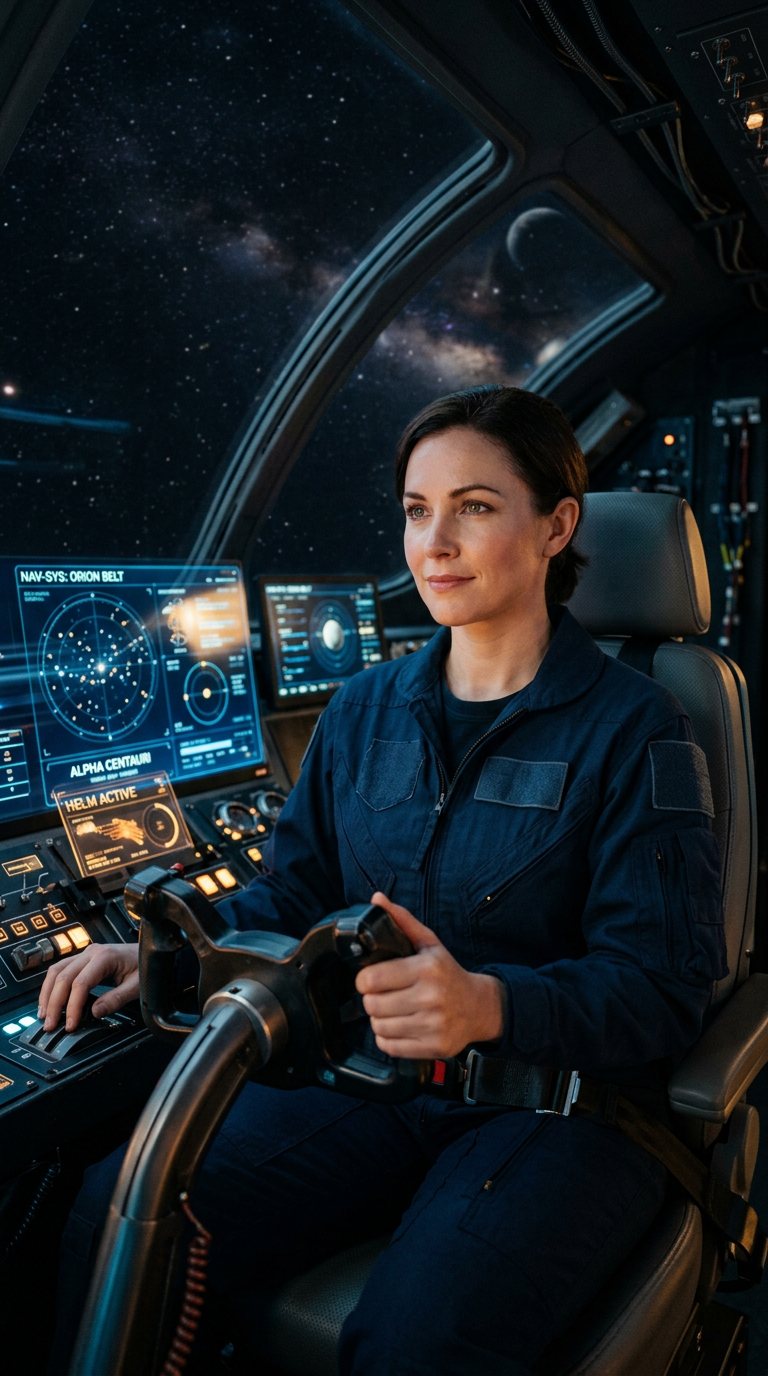
High Captain Karla Wender (Human)
- Time
- 2831 UCSD, Early Winter
- Location
- Threshold Station, Boundary Survey Archive
Wender had read the doctrine on Obligers and Gilded Saints the way she read everything, once for content and once for what it was for, and the thing it was for had always struck her as almost too simple to be a weapon: name what you know, discharge the debt, recognise the closure-prevention pattern, accept that enough is enough. You did not fight the thing that fed on an unfinished story. You finished the story accurately, and it starved.
She had not expected, when she declined to sign the citation, to be practising counter-doctrine against a threat that might turn out to be her own institution. But Syra had put it plainly, and Syra did not flinch things into being softer than they were, and the plain version was this: the Oversight Council's hero's citation and a Gilded Saint's feeding did the same work. Both kept the file shut. Both turned Shepherd from a woman into a meaning. Both made it impossible to ask, ever again, what had actually happened at Dock Seven, because asking would insult the sacrifice — and you must not reopen the sacrifice was the exact sentence a closure-prevention entity most wanted the room to believe, whether or not any entity was in the room to want it.
"So we assume nothing sacred," Wender said. "We assume an open incident with a survivor we haven't recovered, and we write the accurate account, and we find out which of three things has been keeping it open by the simple method of doing the one thing every version of the closure would prefer we didn't."
Sen's desk produced, without editorial, the fourteen-hundred-year-old note and the field data from the nineteenth day, laid adjacent, and let the adjacency argue the way Sen always did. Wender looked at a well running warm across fourteen centuries and a boundary running warm across ten weeks and understood that whatever was at the edge of wherever Shepherd had gone was not a metaphor and not a mercy and not a monster. Present-tense, on this station, with instruments and Syra's boundary science and Rook-7's arrays all pointed at it, it read as a levril — doing the only thing its kind was permitted to do: standing at the edge, holding, refusing to leave, unable to reach in and finish it for her. What the fourteen-centuries-old note added was not proof of the same but a shape too familiar to ignore: a woman at a well who met something she wouldn't name, and a warmth after it that the Union's scholars, much later, had guessed a name for. Guessed. Wender kept the distinction the way Shepherd would have — the entity at Dock Seven she could support; what visited a thorn well in 1216 AD, and whether it had any standing in the Cascade to visit with at all, stayed exactly as open as Aoife had been careful to leave it.
"It can't pull her out," Wender said slowly, working it the way Shepherd would have. "Whatever a levril is or isn't permitted to do, reaching in and finishing a transference isn't on the list — and whatever met Aoife, for all anyone has ever been able to prove, never pulled her anywhere either. It can only keep the channel from closing. Which means whatever gets her out — if anything does — has to come from her, or from us, or from both. Not from the thing holding the door."
"Correct," said Syra, who found this neither hopeful nor hopeless, only true. "Which is why the account matters. It is not a eulogy. It is the rope. If we name what happened precisely enough, we starve whatever is feeding on it staying vague — and we give the woman on the other side of that warm edge one true thing to hold that she did not have to build herself out of her own memory. She has been generating every certainty she has. We can send her one she doesn't have to make up."
Wender picked up the stylus she had set down ten weeks ago, and for the first time since Dock Seven, wrote a sentence about Tissadelle Shepherd that was neither a citation nor a loss. She wrote what was known. It was a short list. She intended to make it longer, and true, and to keep it open exactly as long as the truth required and not one Tuesday less.
Discussion
Show discussion
Comments are read after they are posted and anything unsuitable is removed. Posting needs a GitHub account; reading needs nothing.