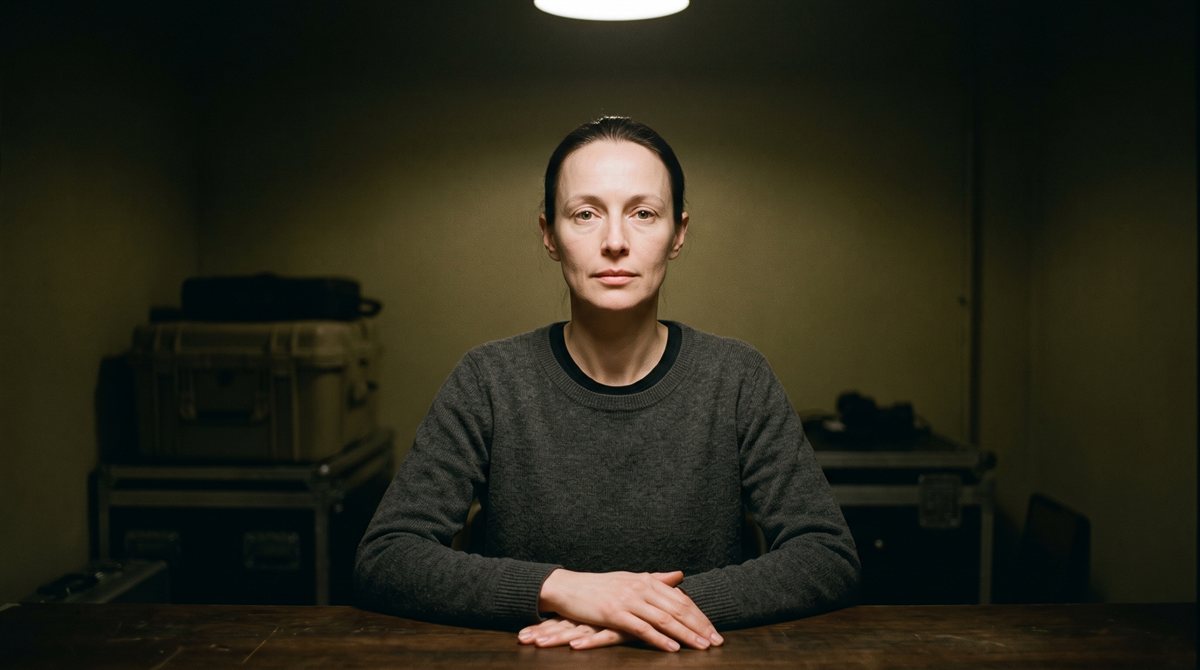
Nai Syra, Boundary Analyst (Krenyi)
- Time
- 2831 UCSD, Early Winter
- Location
- Threshold Station, Boundary Survey Archive
Syra did not experience deep fear, which made her, on a station full of people trying not to hope, the correct person to hold the boundary data. Hope distorted a signal the way fear did — by deciding in advance what it wanted the signal to be. She wanted nothing from Dock Seven except its actual value, and so she was the one who could read the warm signature and say the two things about it that everyone else kept collapsing into one.
"It is structured," she told the room, which was Wender and the desk that Sen kept. "And it is being sustained. Those are separate findings. A thing can be structured because it is alive, and it can be sustained because something is feeding it from outside, and those are not the same claim, and I will not let you treat the first as proof of the second or the second as proof of the first."
This was the discipline, and it was Ranger doctrine before it was Syra's temperament, though her temperament made it cheaper for her than for most: name what you know. Not what you fear. Not what would close the file. What you can actually support.
What she could support: the signal at the failure point had the profile of a stalled process, past saturation, iterating without resolving — consistent with a mind that had not finished becoming something the setting had a name and a governance structure for. What she could support: the warm anomaly matched nothing in the boundary-decay archive, and matched, when Sen laid the two records adjacent, an instrument note fourteen centuries old — a well in Ireland that ran warm for three days after a woman met something at it that she was honest enough never to fully name. What she could not support, and would not pretend to, was the name fourteen centuries of scholarship had since proposed for it. The Union read Aoife's encounter as a Levril one. Read. It had never established that it was, never settled what standing — if any — the thing at the thorn well held in the Cascade, and a matching signature was not going to close for the Union a question the Union had chosen to leave open. Syra flagged the identification as an inference, because it was one, and moved on to what the instruments could actually carry.
What she could not yet support, and refused to pretend she could: whether the reason the process had not resolved was the ordinary physics of an incomplete transference, or a Gilded Saint holding the closure open because a stalled, sanctified, never-quite-finished sacrifice was precisely what such a thing fed on — or the Council's citation doing the entity's work for free, keeping the file shut and the story beautiful and the question closed, with no entity present at all.
"All three are real hazards," she said. "The doctrine for the last two is the same instinct. Precision. But they are not interchangeable, and if we name a Saint that is not there we will have done, ourselves, the exact imprecise thing the doctrine exists to prevent. So we rule out before we name. In order. Starting with the one that costs nothing to check and would embarrass us most to have missed: our own paperwork."
Discussion
Show discussion
Comments are read after they are posted and anything unsuitable is removed. Posting needs a GitHub account; reading needs nothing.