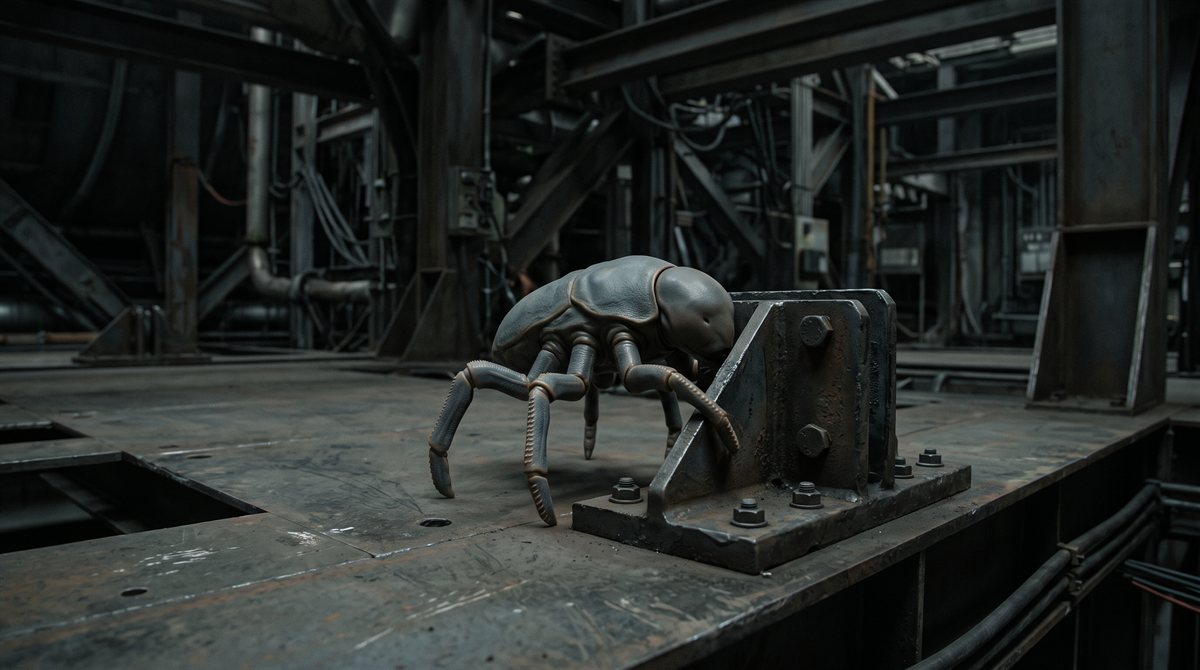
Tikket (Chthonari)
- Time
- 2828 UCSD, Spring — three weeks earlier
- Location
- Eden Space Habitat, Dock Ring understructure
The deck said the habitat was fine, and Tikket had stopped believing it on the second day.
Not in words. The Undersong has no word for a thing being wrong; it has the thing, and the thing was a mount under the dock ring — the third of six the humans' instruments hung from — that rang a little under load where the other five did not. A little. Less than a course-turn in the Long Skitter, less than a novice is marked down for missing. Tikket had felt it through the forelimbs on the first shift, the way one feels a step that is a finger's width lower than the last, and had put it where an apprentice puts such things: with the course, not with the tunnel. Eden was a tunnel nobody had tuned. Everything in it rang a little.
By the second day the other five mounts had settled into what they were, and the third had not.
The cutting itself was finished, which was the difficulty. The crew had cut the new members in the first week — good members, cut to what the ring would still be doing when the cutting stopped, and Tikket had been proud of them in the way one is proud of something that will never be looked at — and the habitat's monitoring had read the whole run and called it normal, and the certification had gone up, and the crew had stayed on for the snagging list. Snagging is the part of a job where one stands on what one has left and listens to it. Tikket stood on it now: on plating that belonged to Eden, listening to a mount that belonged to the Rangers, holding a ring the Compact had certified, with no standing on any of it except the standing that came up through the feet.
Kattik said it was the course. Kattik said Eden's monitoring was six instruments that had agreed with each other since before either of them had stood on a deck, and that a mount rang under load because a mount was under load, and that an apprentice who heard a fault in every unfamiliar structure would spend a career hearing faults. All of which was true. Kattik was rarely wrong about what was true. It was the other thing — what a structure was doing that its record did not say — that Kattik memorised and Tikket had begun, somewhere in the last year, to hear.
There was nobody to tell. That was not a complaint. The humans were kind, the module was sealed, the crew was four on one deck and could feel each other well enough. It was that the one thing Tikket knew for certain here did not travel through air, and everybody who could decide anything lived in the air.
So Tikket did what could be done from the feet. Went back to the third mount at the end of shift, when the ring ran quiet, and stood on it, and listened to it ring under the load of an approach the humans said was normal, and found — with the part of an apprentice that has begun to be an engineer — that it was not ringing wrong. It was ringing right, for a mount carrying more than the certification said it carried.
That was worse. A fault is a fault. A structure doing its job under a load nobody has written down is a structure telling the truth to the one person in the room who cannot repeat it.
Discussion
Show discussion
Comments are read after they are posted and anything unsuitable is removed. Posting needs a GitHub account; reading needs nothing.