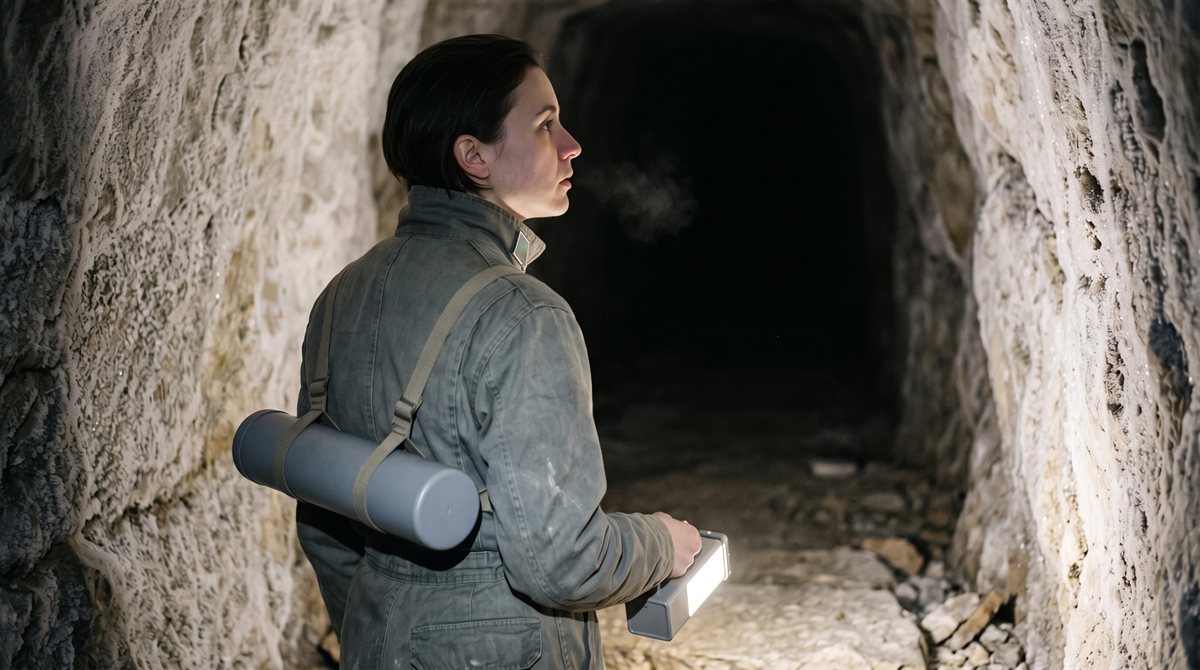
Aravena (Human, Fliade surface party)
- Time
- 2832 UCSD, the survey's second year on the ground
- Location
- Fliade — the upper junction where the surface party works, the station on the roof, and the line in the silt where the party's own tracks stop
Some shifts later the unit was not at the junction.
Aravena saw the empty floor from the bottom of the long passage, before the others, because Aravena was the one who looked for it. The Anstolik do not pick things up. Aravena's stomach went the way a stomach goes when a thing you were responsible for is gone.
Nakagawa said nothing, went to the third passage, stood, and then walked down it slowly with the light held low, and the others followed.
The party had been down there once. Aravena remembered it. The third passage narrowed to a crack you went through sideways, scraping — Egede called it the squeeze and had rated it, in the log, impassable for anything of an adult Pandoid's mass — and on the far side the floor was soft with pale silt, and Nakagawa had walked a little way onto the silt and stopped, and said far enough, and they had all stopped, together, in a line, and turned round, and gone back. The survey did not go down where the deep began. The line was where the rule had stopped them. Their tracks were still there, in the silt, with the edges gone soft.
The unit was standing on the line.
Upright. On its base. Oriented the way the party oriented them, with its face toward the squeeze, toward the way they had come. Exactly on the line where their own feet had stopped, as if somebody had measured it. Nothing on it was scratched.
Aravena knelt to it, the way Aravena knelt to it every shift, and put the handset to it, and read its log. It had slept at the junction. Then, some time after, in transit — in transit, said the log, the unit's own flat word for being moved — it had woken. Thermal trigger at zero range. It had classified the trigger at the highest confidence it had: an upright bipedal profile. And then it had gone back to sleep.
At zero range. Held against something warm, all the way here, and it had woken up and said what it was looking at, and then it had gone back to sleep in the arms of the thing it had just named.
"It came back," said Egede, behind Aravena. "He brought it back. He carried it the whole way, through that, and put it down where we'd find it. That's a courtesy. A dropped thing returned."
"That's a line," said Nakagawa. "Drawn with our own kit, at our own furthest mark, by somebody who watched where we stopped and thought about it."
Aravena did not say anything. Aravena was looking at the unit, straight on the silt with its face toward the party, and thinking that it had not been dropped, and it was not a line, and that neither of them was wrong, and that there was nothing to file, because what Aravena thought was not a reading. It was a feeling, and the survey does not file those. It was put where we would find it. By someone who held it while it woke.
Nakagawa took the light.
Nakagawa swung it the way a person looks: slowly, from the unit, along the silt, over the old tracks and the one new round print beside them, up the slope of the margin and into the dark, as far into the dark as a light like that can reach, which is not far. It stopped where it could not go further. It stayed there a while.
Nothing.
"Lift it," said Nakagawa. "We are not placing anything past this line, and nobody is crossing it. Log that."
Discussion
Show discussion
Comments are read after they are posted and anything unsuitable is removed. Posting needs a GitHub account; reading needs nothing.