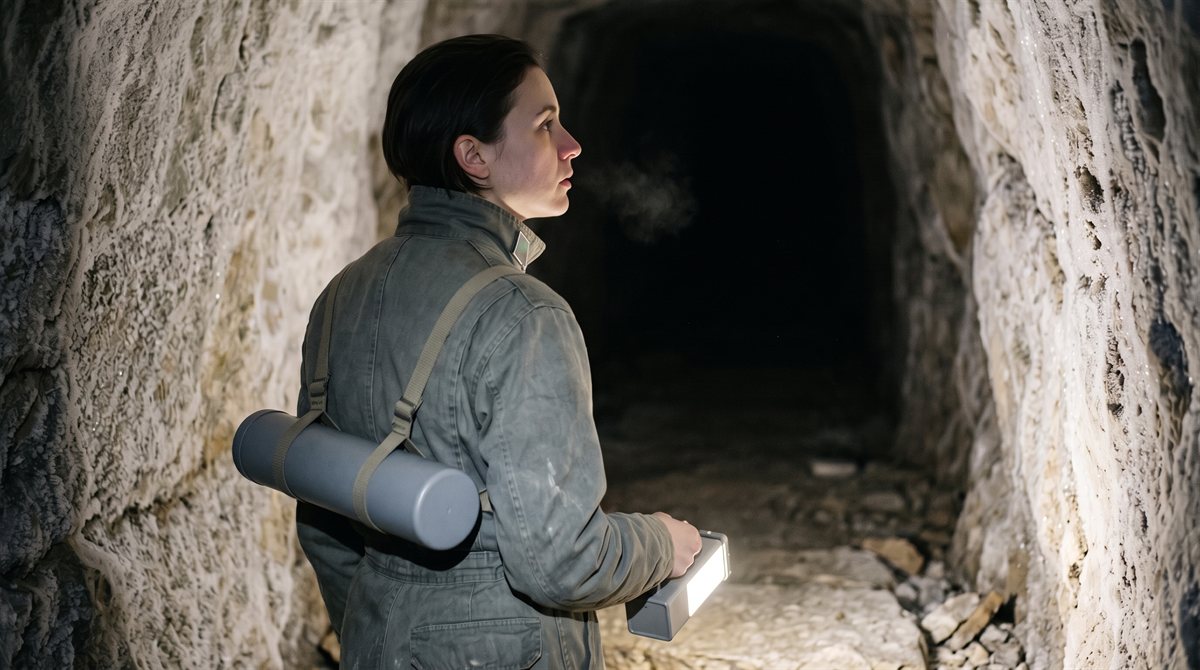
Aravena (Human, Fliade surface party)
- Time
- 2834 UCSD, the survey's fourth year on the ground, some shifts after the junction stopped hearing the line
- Location
- Fliade — the upper junction, the squeeze and the line, and the station on the roof
This is logged the way things are logged on Fliade: by someone who was there. This time nothing else was, by order, and so what follows is in four people, and in nothing that hums.
Aravena knocked.
Shift two-three-four. The stone, the size of two hands, picked at the junction without looking, the way you pick a thing your hand knows. The squeeze, sideways, the stone turned lengthwise, the handheld's hard square against the breastbone, its sound off. The silt. The one on the line, in the open, still, grey, large. Beside it, nothing, and Aravena looked, and did not file the looking.
Kneel. Set it down, a hand from those feet. Step back. Say the thing, going up at the end.
Wait.
The one on the line bent, the way it bent every shift, and put a hand on the rock at the edge of the silt.
And did not move it.
Aravena waited the interval. The party had measured it from the other side a hundred times before anyone knew what it was, and Aravena had stood inside it on more shifts than Aravena had counted, and it had a place in the body now, the way a step you take every day has a place in the leg: a point at which you turn, because by then the rock has always spoken. The point came. The light lay low on the silt, on the feet, on the rock, on the hand on the rock. The hand had not moved. The point went by.
The order was short and Aravena knew it the way you know a thing you have kept two hundred times. Set it down. Step back. Wait the interval. Whatever happens in it, or does not, come back. It had been given at the station on the morning of the first stone, and nobody had touched it since, and Aravena had never once wanted to.
Aravena stood on the silt and thought it through once, because there was nobody else there to.
The interval was for the stone. That was all it had ever been for. The party had measured it before it knew it was an answer, and it was the time an answer took, and the answer had come inside it every time because every time it had been begun at once. This time it had been begun. Aravena could see it begun: a hand, on a rock, at the edge of the light. It had not been finished. A hand on a stone is a stone that is going to move. You do not leave a door while somebody's hand is on it.
So Aravena stayed.
Not deciding to. By the time Aravena noticed the staying it had been done for a while, which is how Aravena had decided most things on this silt, and had once said so to Ferrant, and Ferrant had written it down.
Then the one on the line said something.
Not the ground. Not a rock. A sound came from the one on the line, low, not loud, and it had a shape, the way a voice has a shape and a rise does not. Aravena's own thing, said at the end of the knock, was one shape going up. This had a great many, going up and down and along, one after another, and it did not stop at the end of the first of them, or the tenth.
It was said to Aravena. The light was low and Aravena did not lift it, and did not need to. A thing said at you from an arm's length is said at you.
Aravena did not know one word of it, and knew it was being said, and stood for it the way the one on the line stood on every shift, which Aravena had watched for two years and never once done: with the whole body still, so that nothing Aravena did would get into it by mistake. The breath came back from the squeeze and went ordinary. The light stayed where it was. The handheld pressed its square into the breastbone and kept whatever it kept, pointed at a hand on a rock.
And it went on.
Discussion
Show discussion
Comments are read after they are posted and anything unsuitable is removed. Posting needs a GitHub account; reading needs nothing.