Aoife
Also known as: Saint Aoife, Aoife of the Thorn Well
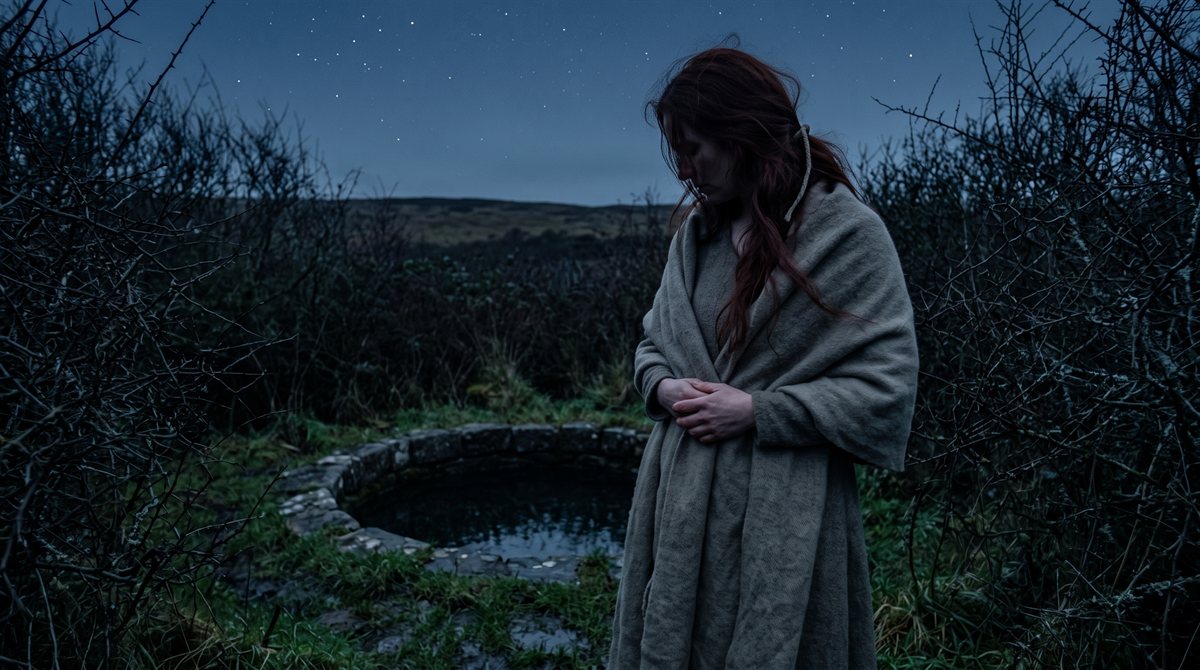
Aoife never claimed to know what she'd met at the thorn well. That refusal is the one thing about her every later reader — devout, sceptical, or reading from a cosmology she couldn't have imagined — has taken at face value.
She came to the well in her fourteenth year already carrying a stillness the older women of Cill Aoife found more unsettling than reassuring, and never fully explained it to anyone's satisfaction, her own included. She took no husband, accepted no dowry offered her, and spent the rest of her life tending the sick who came to the well for its healing repute — first as a local custom, later as something closer to a calling, though she resisted the word when it was offered to her.
The Vision
On the eve of Saint Muirenn's feast in her thirtieth year, keeping her habitual solitary vigil, Aoife experienced whatever it was Brother Daire's account preserves in fragments: a presence too large for the clearing to hold and yet held by it, occupying "every distance at once," folding the air without tearing it. She named it Muirenn, because the date and the setting gave her little else to name it — and then undercut her own naming in the same breath, telling Daire plainly that the shape resembled nothing in the community's devotional carvings of the saint. She never resolved that contradiction publicly. Nothing in the surviving record suggests she tried to.
What she would say clearly was the distinction between having been shown something and having been healed by it — two different claims she refused to collapse into one, even when collapsing them would have made her easier for the community, and later any higher devotional authority, to categorise.
Known History
- Born c. 1186 AD, parentage and townland of birth not preserved in the surviving record.
- Began tending the sick at the thorn well of Cill Aoife in her fourteenth year, prior to the vision that would later define her.
- Experienced the vision recorded by Brother Daire in her thirtieth year, c. 1216 AD.
- Refused three separate offers to enter a formal religious house, continuing lay devotional work at the well instead.
- Died in the winter of 1241 AD, tending the well to the end; recognised as a saint only by sustained local usage, never by any formal process from a higher authority.
Character Notes
Aoife's most striking trait, on the evidence of the one document that survives her, is that she never resolved ambiguity she was in a position to smooth over. A less careful witness to her own experience could have simply confirmed Muirenn and let the story settle. She didn't. She told her chronicler what didn't fit as readily as what did, and let the discrepancy stand in the record rather than edit it out for the community's comfort or her own.
That same refusal is what makes her legible, fourteen centuries later, to readers working from a taxonomy she never had access to. The Celtic Union's cultural scholars who now read her account against Levril classification are not correcting her. They are, by the Union's own account, simply the latest people trying to name what she was honest enough to say she couldn't fully name herself.
She kept no formal writings of her own. Everything known of her interior life passes through someone else's hand — Brother Daire's, and now a chain of devotional and scholarly readers stretching from medieval Ireland to the charter worlds of the Celtic Union. She would likely have found that unsurprising. She spent her life being asked to explain something she'd already told everyone, honestly, she couldn't fully explain.
See also: Saint Aoife, The Life of Saint Aoife, What Was Carried, Brother Daire, Levrils: Dragons and Constraint Literacy.
Discussion
Show discussion
Comments are read after they are posted and anything unsuitable is removed. Posting needs a GitHub account; reading needs nothing.