Brother Daire
Also known as: The Chronicler of Cill Aoife
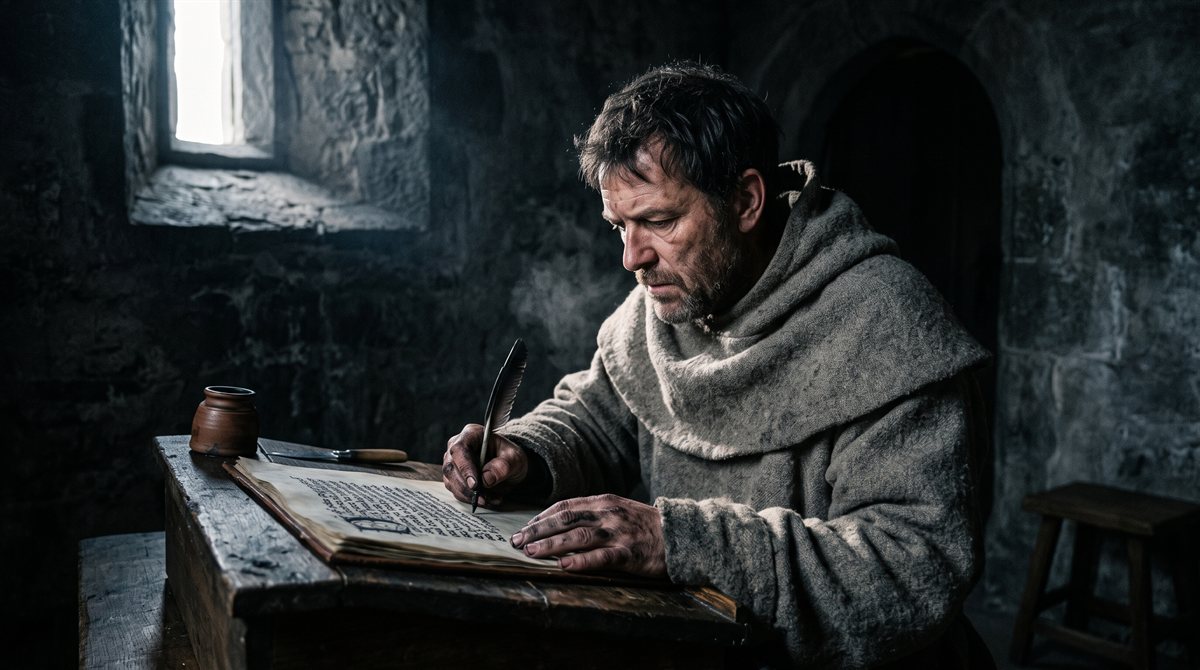
Brother Daire calls himself unworthy in the very first line of the only document that has kept his name alive for fourteen centuries. The record does not argue with him, and does not need to. It simply keeps circulating anyway.
He was not the one Aoife confided in most closely. That distinction matters to how his account reads: he was, by his own careful phrasing, the person the Cill Aoife community deputised to set things down — a role distinct from the one meant to hear what she could not otherwise say aloud. Aoife would not describe her vision at the thorn well fully even to the one she trusted most. What Daire recorded, he recorded from the fragments she chose to permit written, and he says so plainly rather than filling the gaps with invention. That single editorial habit — mark what is confirmed, mark what is assembled, and never blur the two — is the reason The Life of Saint Aoife has survived close reading by scholars working from a completely different cosmology than his own, fourteen hundred years and one interstellar migration later.
Known History
- Community scribe at the monastic settlement of Cill Aoife, Ireland, in the early thirteenth century.
- Recorded the sole surviving account of Saint Aoife's vision at the thorn well, dated by his own hand to 1216 AD.
- No confirmed birth or death date survives; the record that preserves his writing does not trouble itself with preserving his biography.
- His manuscript was copied and recopied through the medieval and early modern period before a nineteenth-century transcription was carried off Earth by the Currach Fleet's founding scriptorium, 2561–2589 UCSD.
- The Celtic Union's Ceridwen Archive on Aethelrock now holds the currently cited copy.
See the timeline entry for the writing itself: The Life of Saint Aoife Set Down at Cill Aoife.
The Dún Rí Question
A Brother Daire keeps an old river abbey on a tidal stretch of the Boyne near Dún Rí — a contemplative chapter of the Fellowship of Light — fourteen centuries after the Cill Aoife manuscript was written, and he is the Brother Daire that Elvira walks down to twice in 2822 UCSD. Whether he is this man, a later namesake in the same tradition, or a title carried by whoever holds the smithy-and-scriptorium role at that abbey, no record that has surfaced settles. This page describes the scribe of 1216; it does not claim the two are one person, and does not claim they are two. The Archive's habit governs the rest: a shared name is not evidence of a shared identity, and saying so plainly is better than letting the coincidence do uncredited work.
Character Notes
Daire's own puzzlement is part of the record he left. He notes that Aoife drew a distinction between having been shown something and having been healed by it, and confesses — in the text itself — that he did not understand the distinction at the time he wrote it down. He preserves it anyway, rather than resolving it into something he could explain. That choice is, in miniature, the reason the account survives two readings at once: a monastic scribe who trusted the discipline of accurate recording over the comfort of a settled interpretation left room, without meaning to, for an interpretation he could not have imagined needing.
Nothing in the surviving record suggests Daire ever doubted what Aoife told him. Nothing suggests he was certain, either. He wrote what she permitted him to know, named the parts he didn't understand as not understood, and let the document do whatever work it was going to do without him. It has been doing that work for fourteen hundred years.
See also: Saint Aoife, The Life of Saint Aoife, The Celtic Union of Planets, The Life of Saint Aoife Set Down at Cill Aoife (timeline), The Second Visit to the River Abbey (timeline).
Discussion
Show discussion
Comments are read after they are posted and anything unsuitable is removed. Posting needs a GitHub account; reading needs nothing.