Aethelrock
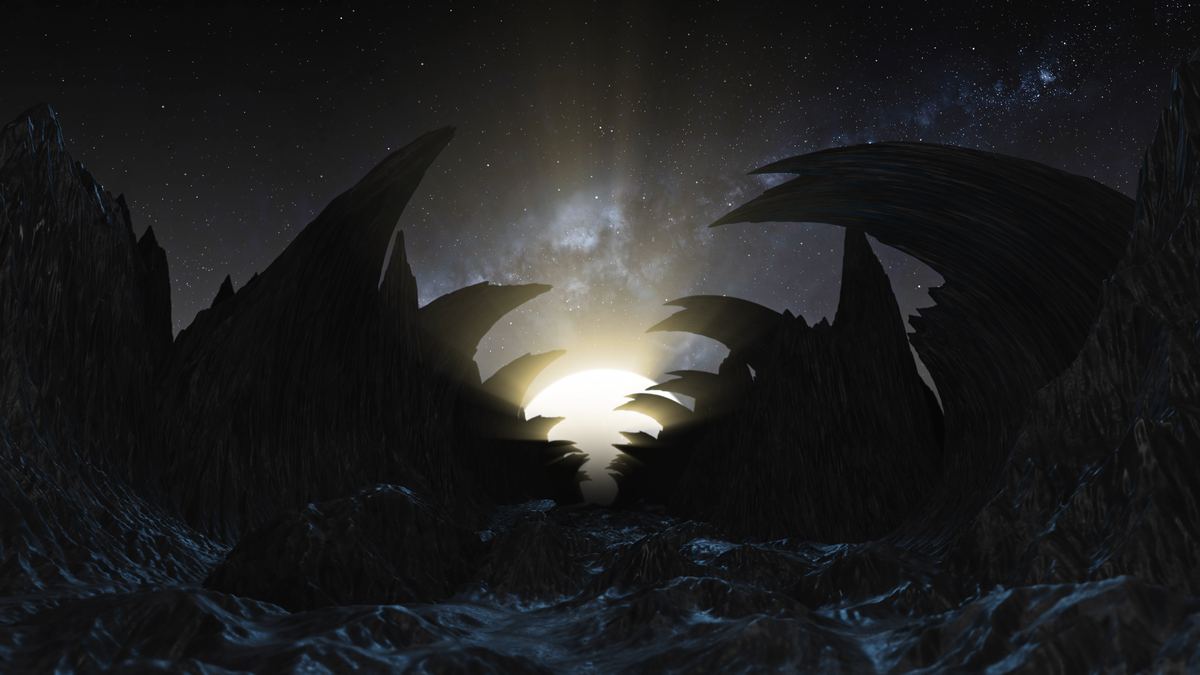
Ask a Union diplomat which charter world is hardest to get a straight answer from, and the answer is not Ynys Wydrin, where the trouble is the air. It is Aethelrock, where the trouble is agreeing on who gets to speak.
Aethelrock is the fourth planet of the Bruane System and the third documented charter world of the Celtic Union of Planets, after Tír na nÓg and Ynys Wydrin. Its ark cooperative found a cold, high-relief world of granite ridgelines and short growing seasons, and rather than settling it as a single polity, split along the lines the ark's founding families had already half-drawn on the crossing. What arrived as one ship's manifest left the ground as several clans, and has stayed that way for eleven generations.
Landfall and the Split
The ark that reached Bruane carried five founding cooperatives that had never fully merged during transit — old disagreements over land tenure and grazing-rights custom, carried out of Earth's own crofting disputes and never resolved before departure. Survey data showed no single site generous enough to hold all five comfortably, and rather than force a shared settlement, the founding council let each cooperative claim its own valley or ridge system and govern it on its own terms.
The glens the clans divided were cut by ice, long before anyone arrived to argue over them: Aethelrock carried glaciers once, in a colder age of its own, and the ice that ground its valleys out of the granite is entirely gone — an old world even in this, that its ice is finished. What the glaciers left is the land the whole polity is drawn on.
The five founding claims hardened into the clans Aethelrock still keeps: Clan Dubhghlas, holding the southern lowland glens and most of the world's arable ground; Clan Aonghas, holding the eastern granite highlands and the bulk of the mining claims; Clan Ó Ceallaigh, holding the coastal fjord country and the fishing fleets; Clan Ceridwen, holding the central plateau and the world's only major fold-relay station; and Clan Bryneth, holding the northern high country, thinly populated and fiercely defended out of proportion to its size.
Government Without a Government
Aethelrock has no planetary executive. Each clan holds full internal sovereignty over its own territory — law, land tenure, resource allocation — answerable to no authority above the clan council itself. The nearest thing to a shared institution is the Ridgemoot, a gathering of clan heads that convenes twice a local year on neutral ground at the plateau border between Clan Ceridwen and Clan Aonghas territory, to settle boundary disputes, coordinate defence, and — increasingly, since reconnection with the Solar System — decide what Aethelrock tells the rest of the Union.
The Ridgemoot has no standing enforcement power. Its resolutions bind only as far as the clans that show up choose to honour them, which in practice means most resolutions hold, because no single clan can defend its territory against the other four combined, and everyone on Aethelrock has done the arithmetic. It is a peace kept by mutual deterrence dressed in the language of custom, and clan elders will tell a visitor, without much embarrassment, that they know it.
The Problem of One Voice
The Celtic Union's charter requires each member world to speak with a single delegated voice at council. Aethelrock has never fully solved this. For most of its history, the five clans rotated the Union seat on a fixed schedule, each holding it for a set term regardless of who currently had the strongest claim to speak for the world's actual interests — a solution nobody loved and everybody preferred to the alternative.
Reconnection with the Solar System strained the arrangement badly. Clan Ceridwen, holding the fold-relay station, found itself the practical point of first contact for Star Rangers survey traffic years before the rotation would have handed it the Union seat, and used the position to negotiate directly rather than wait its turn. The other four clans have not forgotten this, and the next Ridgemoot is expected to renegotiate the rotation rather than simply confirm it.
Settlement Character
Aethelrock follows Ynys Wydrin's register more than Tír na nÓg's: a hard world where technology stays visible because pretending otherwise gets people killed. Clan holdings run to weatherproofed stone longhouses with exposed heating conduits and drone-serviced grazing fences, not the recessed, softened tech of the biosphere worlds. Where the clans differ sharply from Ynys Wydrin is in the culture layered over that hardware — tartan-woven cold-weather cloth in clan-specific setts, contested grazing marches still walked on foot once a season to keep the boundary memory alive, and a body of clan law that predates the Union charter by generations and answers to it only when convenient.
What the world supplies is air, water and ground, and what grows and grazes on it came off the ark. Aethelrock's atmosphere is a native biosphere's, and that biosphere is in its seas and on its rock, a mosslike cover on the granite and a thin life in the fjords that the Survey Corps logs and the Union's protocols do not harvest; the land fed nobody before landfall. Clan Dubhghlas's arable is Terran crop stock hardened to a short season and worked under the cold-world methods Ynys Wydrin develops for the whole Union, under glass where the season is shortest; the flocks on every clan's grazing descend from Currach Fleet stock, as Tír na nÓg's uplands' do; and Clan Ó Ceallaigh's fleets fish stock the founders introduced to the fjords, not what the fjords held. Nothing native to Aethelrock is eaten. The world is breathable, which is rarer than it sounds in this record, and it is not compatible, which is rarer still and is one world's alone.
Clan Avalon: A Fellowship Without Ground
Not every clan on Aethelrock holds a valley. Clan Avalon is not one of the five Ridgemoot houses and claims no Ridgemoot seat — it is a cross-clan bardic fellowship, drawing members from all five landholding clans rather than competing with them, organised around keeping alive the old myth-cycle its name comes from: the Arthurian Avalon, the same legend that already gave Ynys Wydrin's home system its name, the Avallach System. Where the five landholding clans compete over grazing marches and Ridgemoot rotation, Clan Avalon's members compete for something with no acreage attached — whose telling of the old stories gets asked for at a founding-day gathering.
Membership carries no land claim and settles no boundary dispute, a deliberate design the five landholding clans have never seriously challenged, since a fellowship with nothing to seize is a fellowship nobody has to fight. Its best-known modern work has circulated widely enough off-world that Solar System listeners occasionally mistake it for something older than eleven generations. See the codex for the recording: Clan Avalon's Anthem (external link — hosted on YouTube, not archived).
Role in the Union
Aethelrock's formal contribution to the Union is smaller than its population would suggest, precisely because its five-way internal politics consume most of the diplomatic bandwidth its delegates would otherwise spend on Union business. What it offers instead is defence: Aethelrock fields the largest trained militia of any charter world, a direct consequence of five clans that have spent eleven generations maintaining forces to deter each other, now nominally pointed outward under Ridgemoot coordination. Union planners consider it the confederation's most capable world in a crisis and its least predictable in a council session, and have learned to plan around both.
See also: The Celtic Union of Planets, Ynys Wydrin, Tír na nÓg, Clan Avalon's Anthem.
Discussion
Show discussion
Comments are read after they are posted and anything unsuitable is removed. Posting needs a GitHub account; reading needs nothing.