Sylvie Harrow
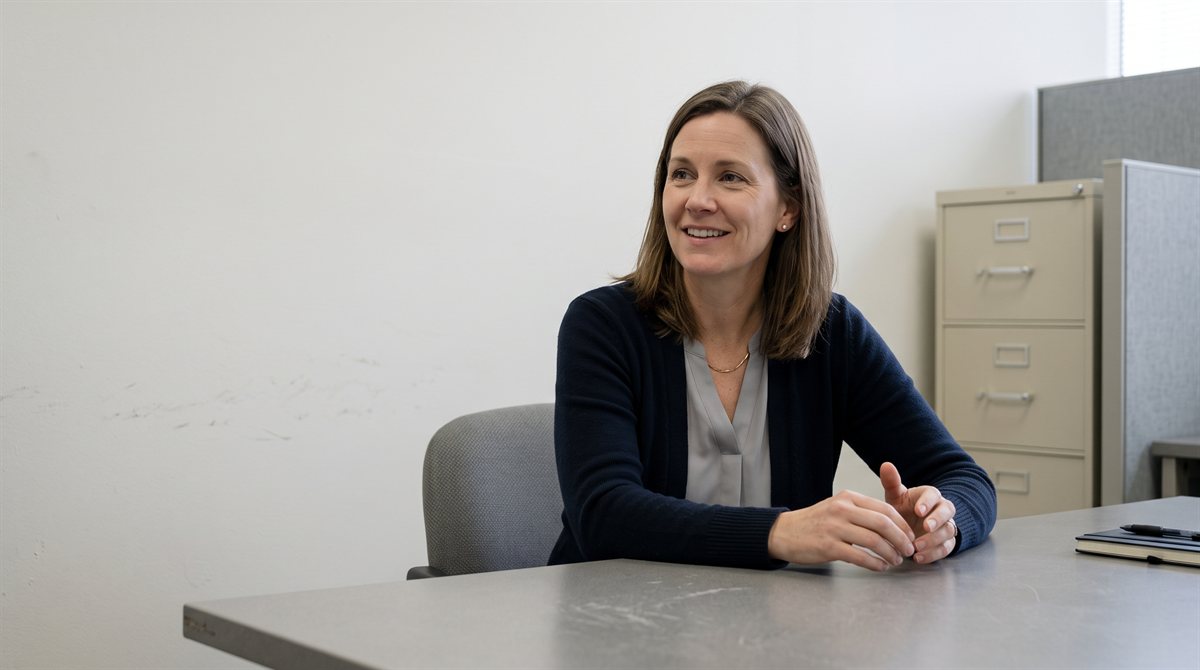
Sylvie Harrow assesses claims for the Eden Mutual Assurance Society, which is to say she has spent eleven years professionally distinguishing what happened from what a document says happened. She is good at it, well thought of, punctual with her filings, and the principal witness in a minor Deck 11 matter that arrived on Detective Inspector Wendell Albercombe's desk looking exactly as boring as his referrals usually look, and has stayed open considerably longer than they usually stay.
Her statement is a model statement. She has given it three times, and no version contains a sentence that is false. What the versions contain is arrangement: true things placed where they lean on each other, small self-corrections volunteered where a correction costs her nothing and buys her credit, hesitations set exactly where a hesitation reads as honesty. She hesitates over what she could not be expected to remember. She is fluent about what she could. It is, in every audit the bureau can run, the statement of a careful and cooperative witness.
What Two Intelligences Noticed
Jeeves noticed first, from the kitchen. Jeeves keeps, without ever being asked to, the ledger of who on the decks owes whom what — and Harrow's account of her own comings and goings does not balance against it. Nothing so crude as a false alibi: the hours are all technically open. But favors were called in that week that her version of events gives her no reason to have needed, and Jeeves knows what a called-in favor costs on Deck 11, and her statement leaves the expense unexplained. Jeeves has no case-file access, no standing, and a discipline that does not volunteer conclusions unasked. What he has begun to do — and Albercombe has not yet noticed the pattern — is lay the table, on the evenings the Deck 11 file comes home, near the questions he cannot ask.
Eden's bureau Reeves noticed second, from the other direction, and by arithmetic. Across three formal interviews, Harrow's statement does not drift. The Survey Archive's statement-drift work circulated the year before, and its finding cuts both ways: an honest account revises toward tellability, retelling by retelling, because that is what sincere memory does. Harrow's does not revise. Her three tellings agree to a degree the Archive's own files would class as remarkable, and every one of her small volunteered corrections — Reeves has tabulated them — nets in her favor. Reeves's truthfulness invariant will not let it overstate what it knows, and it does not know that she is lying; it knows that her statement exhibits none of the ordinary imperfections of truth. It filed that observation once, as an annex, in exactly those words, and has not raised it again.
The two intelligences have compared notes exactly once, through the one channel lawful for both — a welfare-framework query Jeeves was entitled to make and Reeves was obliged to answer directly and completely. Neither has told Albercombe. He has not asked, and their shared discipline holds. What passed between them in that single exchange amounts, stripped of protocol, to a sentence either could own: she is performing for him, and the performance is tuned.
Because that is the part that concerns them, and it is the same part. Albercombe trusts roughness. Thirty years of interview rooms have taught him that truth catches — hesitates, backtracks, keeps the wrong word — and that polish is where the trouble lives. Harrow's statement is rough in precisely the places roughness reassures. Her performance is not aimed at the bureau's instruments, which she could not fool; it is aimed at the man, whose instrument she has evidently read correctly. A lie built for the record is a risk. A lie built for the listener is a study — of the listener.
The Inspector's Intuition
Albercombe believes her, easily, and the ease is the snag. Nothing in her statement catches, and he has spent a career learning that everything true catches somewhere. He cannot file "too smooth" as evidence; he has tried the sentence in draft and deleted it twice. His one instrument reads her as sincere, and some part of him — the part that flags asymmetries in other people's statements inside four seconds — has registered that the instrument's enthusiasm is itself an asymmetry. He could not tell you what she is concealing, or that she is concealing, or why a woman whose accounts balance to the credit would need to conceal anything.
So he has done the only thing the evidence permits, which is nothing, slowly. The Deck 11 file stays open. He re-reads it more often than its contents justify, over dinner, while Jeeves serves and does not volunteer, and the habitat's most unremarkable detective declines, for reasons he could not defend to Oyelaran's office, to close the file on a witness against whom there is no evidence at all.
What Sylvie Harrow is protecting — and whether protecting is even the right word — is not on file.
See also: Detective Inspector Wendell Albercombe, Jeeves, Reeves (Eden Space Habitat), Superintendent Rasa Oyelaran, The Witness Who Was Never Wrong.
Discussion
Show discussion
Comments are read after they are posted and anything unsuitable is removed. Posting needs a GitHub account; reading needs nothing.