Trígrian
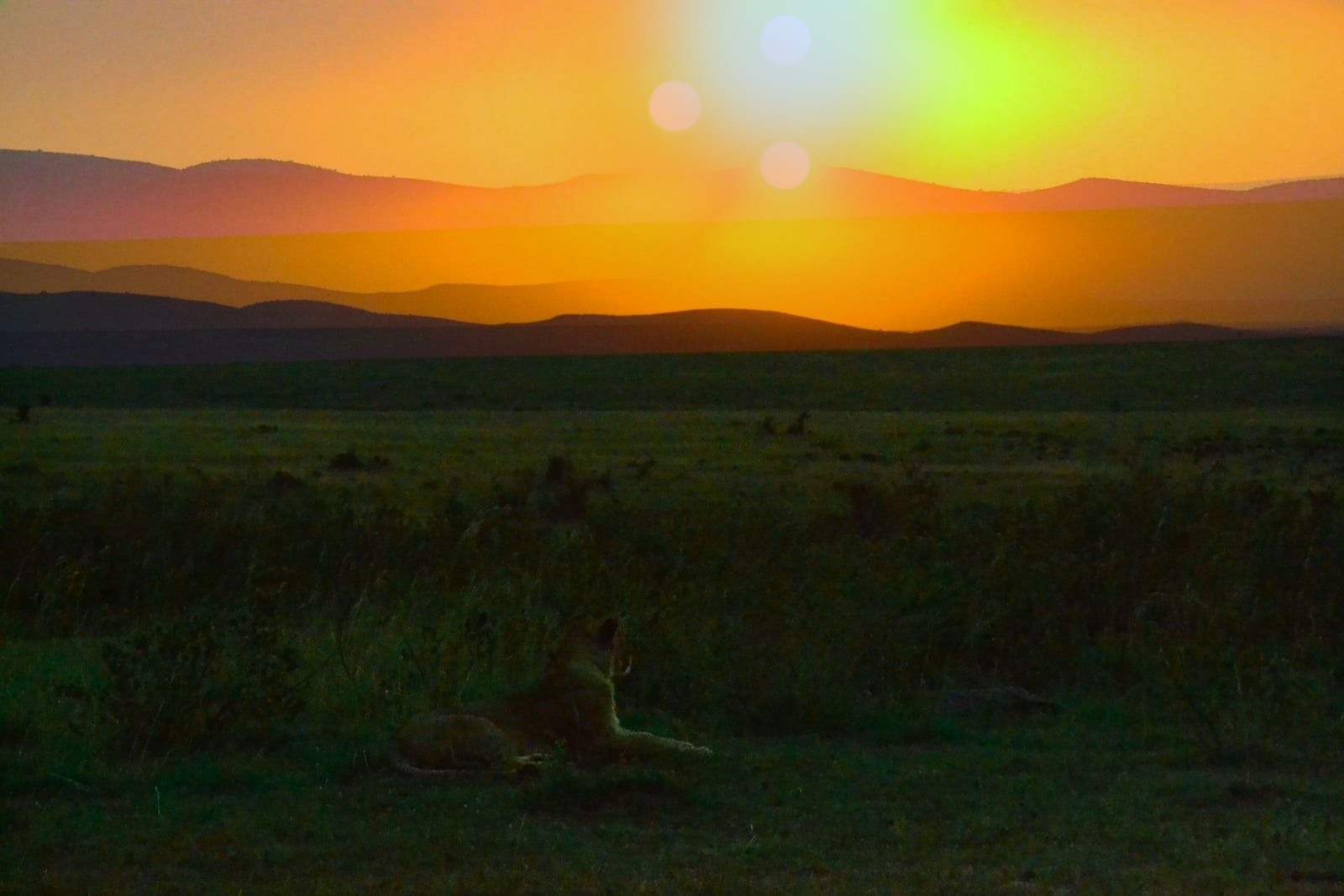
The first survey report filed from Trígrian's surface opens with a wildlife observation and a formal request for an investigation into who, exactly, had been seeding lions on an uncharted world. The investigation was closed within the season. Nobody had. The second report, filed after the survey's first triple-sunset season, opens with a casualty list.
Trígrian is the second planet of the Triúr System, a hierarchical trinary: a tight central pair of orange suns circling each other close enough to share a sky, and a smaller, whiter companion on a wide, eccentric outer orbit. The planet rides a stable circumbinary track around the inner pair — stable in the orbital-mechanics sense, and in no other. Its distance from the paired suns varies enough over each orbit to swing surface insolation by double-digit percentages, and the outer companion adds a slower cycle on top: for most of a generation it is a bright star, and then for a run of years it is a third sun that matters. Trígrian's climate is not a pattern with seasons. It is a negotiation between three heat sources that never repeats exactly, and everything alive on the planet is built for the disagreement. The name — from the old Irish for three suns — was entered in the register by a Celtic Union cartographer seconded to the survey, and stuck the way informal names do when the alternative is a catalogue number.
A World Built for Whiplash
Trígrian has no polar caps, no forests, and no year that resembles the one before it. The land is grass because grass is what survives a climate that can deliver a decade of generosity and follow it with a burning season that kills the standing cover across a continent: deep-rooted, fast-seeding, fire-adapted, dormant within days when the heat spikes. The herd species are nomads on a scale Earth never required — migrations that track rainfall across thousands of kilometres because nothing about the rainfall can be assumed. Standing water is temporary everywhere on the planet. The rivers the survey named in its first season had moved by its third.
The violence of the cycle is also the engine of the planet's fertility. Ash from the burning seasons and dust off the dry plains feed soils of exceptional depth, and the recovery flushes that follow a hard year are, in the survey's own register, disproportionate — grasslands re-greening at speeds the botany team initially attributed to instrument error. Trígrian is not a marginal world scraping by under a bad sky. It is a rich world that collects its rent in advance.
The Triple Sunset
For a stretch of tendays whose timing shifts with the outer companion's approach, Trígrian's geometry brings all three suns into the same quarter of the sky, and at dusk they go down together: the close pair side by side, the white companion trailing them to the horizon. Atmospheric dust stretches the event into a slow amber descent that survey crews have been known to schedule shore rotations around, and which the first report's author — in a document otherwise composed entirely in survey register — called worth the transit on its own.
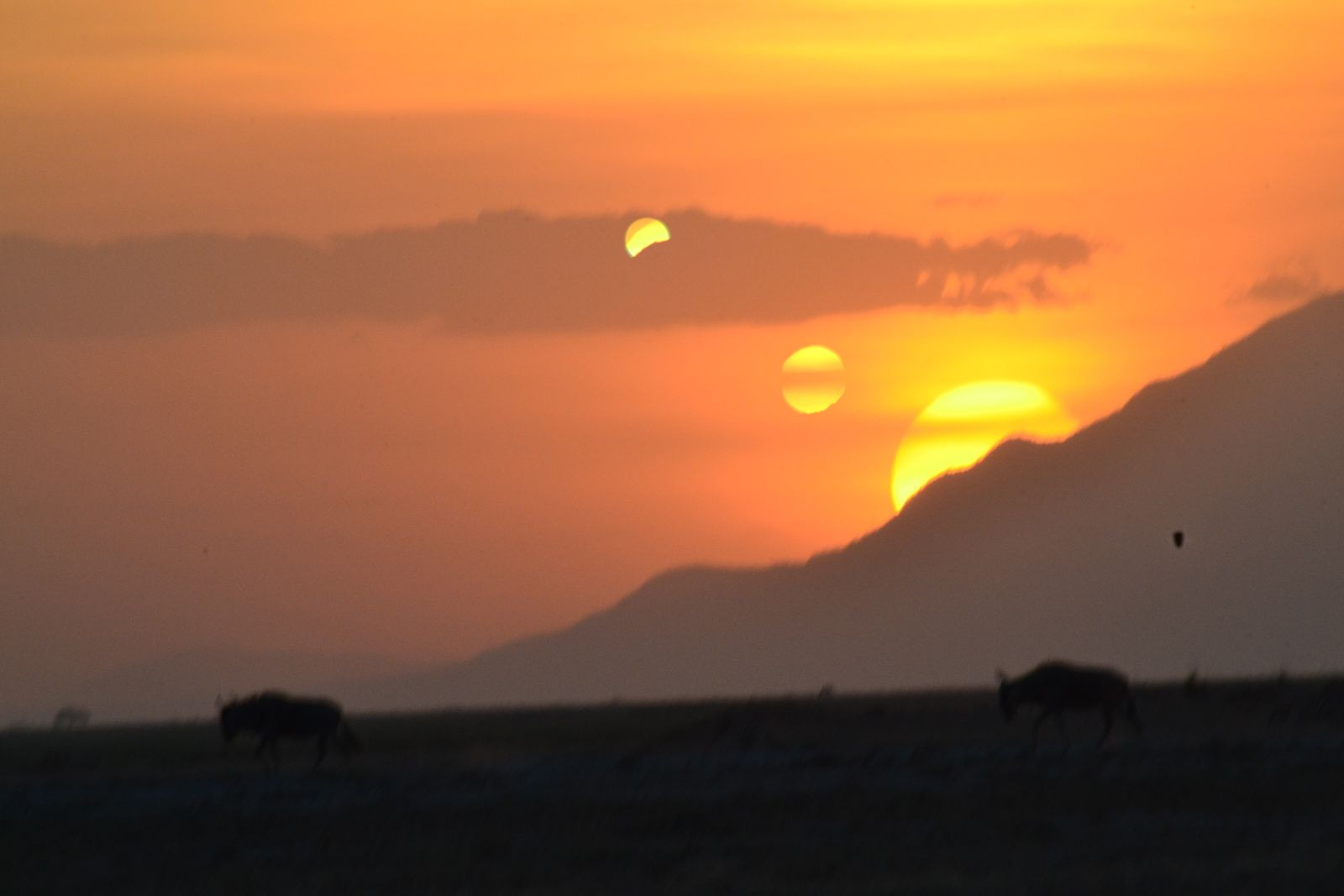
The beauty is a warning. Three suns in one sky is the planet's insolation maximum: the triple sunset opens the burning season, when the combined heat load cures the grasslands to tinder, the dry storms arrive, and continent-scale fires redraw the map. The herd species read the same sky the survey does and are already moving before the suns converge; the predators move with them. The second survey rotation learned the planet's calendar the hard way — a field camp sited on good summer ground that stopped being ground at all inside a tenday — and every rotation since has kept the station's fire-break perimeter as its first standing maintenance task.
A Lioness That Isn't
The observation that opened the first report remains the planet's calling card. Trígrian's apex grassland predator is, at any distance a field scope closes, a lioness: the build, the tawny coat, the low patient posture in cover, the social hunting in related groups. The resemblance was close enough that the survey lead — aware that Terran stock has turned up in strange places before, and that SSDC's genetic archives have made big cats a maintained lineage rather than a lost one — treated deliberate seeding as the conservative hypothesis and filed accordingly.
The biochemistry closed the question the way it closed the botanist's on Tír na nÓg: pigment chemistry first, then protein handedness, then a reproductive strategy nothing Terran shares — the "prides" are sororal colonies that share a single breeding matriarch, and the matriarch breeds on the planet's calendar, not her own, holding fertilised embryos in diapause through the burning seasons and bringing a generation to term only when the recovery flush commits. Trígrian's lioness is convergence, not descent: the same grassland problem — big migratory prey, cover that rewards ambush, heat that punishes solitary pursuit — answered the same way twice, twelve hundred light-years apart, and then answered harder, because Trígrian's version of the problem includes years in which the grassland itself burns to the horizon. Survey crews call the species the grianmhór (the report's glossary translates it, unapologetically, as big sun-cat), and the entry has become the standard teaching example in Ranger xenobiology induction: resemblance is evidence of shared problems, not shared ancestry — and the closer the resemblance, the harder the shared problem usually was.
Survey Status
Trígrian holds a standing multi-generational survey window under Frontier Transformation Protocols — not because anyone has proposed transforming a world this committed to its own weather, but because the protocols' sapience clause applies with unusual force to a biosphere this behaviourally sophisticated. The grianmhór colonies coordinate hunts and burning-season evacuations across kilometre distances by means the survey has not yet fully characterised, and colonies have been documented moving ahead of fires along routes no colony member alive had travelled. Until the survey can say what is doing the remembering, doctrine treats the question of Trígrian's ceiling as open.
No settlement authorisation exists, and none has been requested; the survey's own assessment is that a world whose climate cannot be scheduled would make a colony a permanent emergency. The only human presence is a rotating station on the northern plateau — hardened, fire-broken, and deliberately overbuilt — staffed lightest in triple-sunset season, when standing doctrine moves everyone who can be spared off-surface, and everyone who remains finds a reason to be on the observation deck at dusk.
See also: The Crisis Centuries: Terran Wildlife from Collapse to Stewardship, Frontier Transformation Protocols, Tír na nÓg.
Discussion
Show discussion
Comments are read after they are posted and anything unsuitable is removed. Posting needs a GitHub account; reading needs nothing.