Verdani
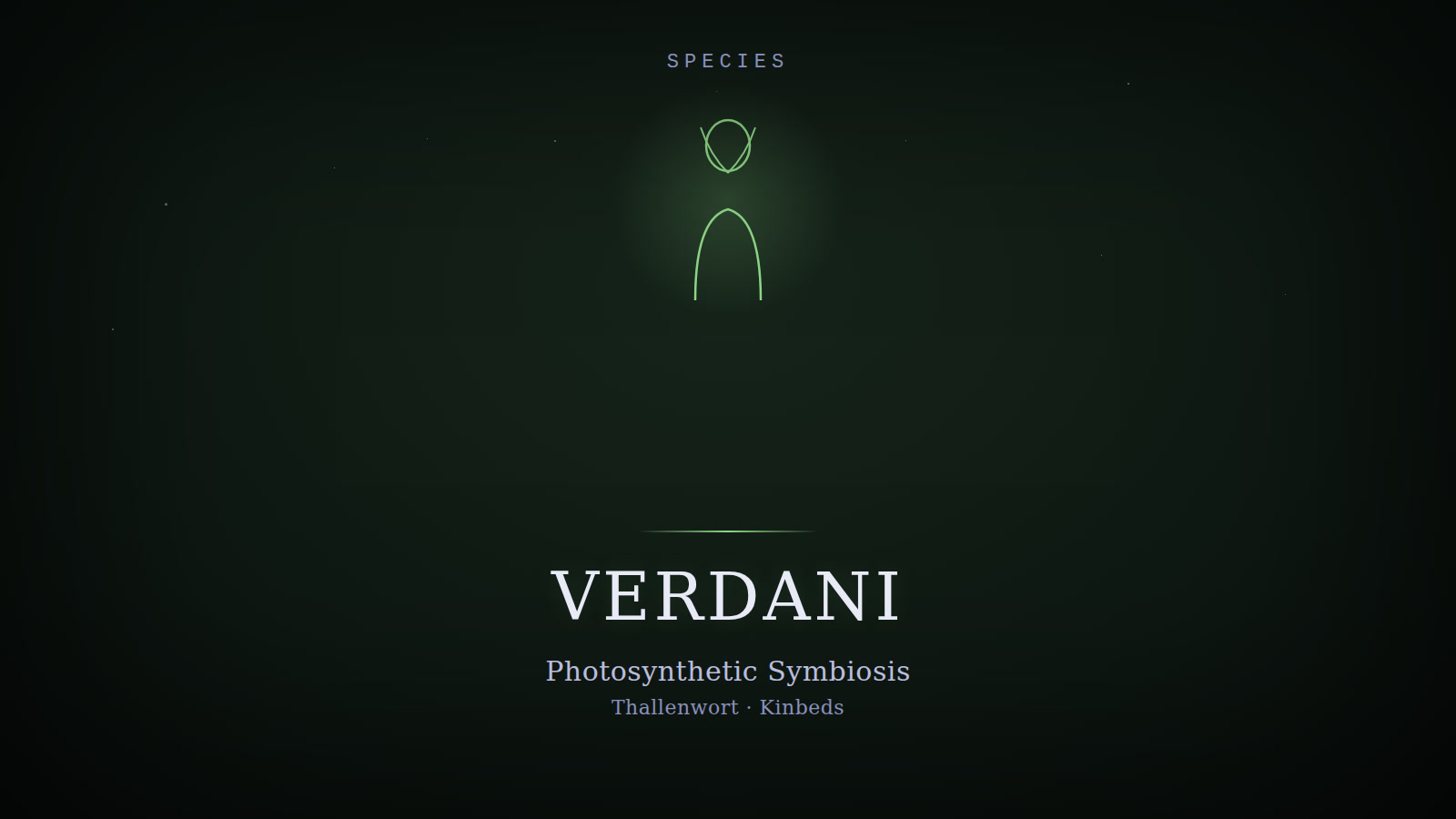
A xenobiologist's first Verdani skin sample usually produces the same two-part surprise: it is not skin pigment causing the color, and the organisms causing it are not passengers.
The Verdani are a sapient people native to Verdance, distinguished from every other catalogued species by an obligate symbiotic relationship with thallenwort — a photosynthetic microflora that colonizes specialized dermal structures called kinbeds from early infancy and remains for life.
The Body the Symbiosis Requires
A Verdani is not humanoid, and the reason is arithmetic rather than aesthetics. Thallenwort pays a share of the daily caloric budget, and photosynthesis pays by area. A compact body with a small ratio of surface to volume — a torso, four limbs, a head — presents almost nothing to the sky and would make the symbiosis a decoration rather than a metabolism. What the partnership actually demands is a body organised the way a plant is organised: to be spread out.
So the kinbeds are carried on broad extensible vanes, held folded when the light is poor or the work is close, and opened when there is sky worth taking. A Verdani at rest in good light is a considerably larger object than the same Verdani crossing a corridor, and the difference is not display or mood — it is eating.
The rest follows. A body that unfolds is low-slung and multiply supported rather than balanced on two points, because a broad opened frame in a gust is a sail and needs anchoring. There is no single face — sensory structures are distributed along the leading margins where the vanes meet, which is why Verdani read as attentive from every direction and why outsiders never quite learn where to look when speaking to one. And a Verdani orients continuously, in the way a person aboard a ship holds their balance: an unconscious, unbroken adjustment toward the light that other species eventually stop noticing and never entirely stop finding strange.
The record's one anchor here is Isren Farrowkin's own account of why her people care about boundary data: a species whose own biology depends on knowing exactly which light a given patch of ground receives has an unusually direct stake in accurate mapping. That is not a metaphor about politics. It is a statement about lunch.
Light Is the Budget, and Haste Is Expensive
The Verdani are the record's clearest case of a technological people limited not by materials or manipulation but by energy per day. A symbiont-supplemented metabolism is a reliable one and it is not a large one, and it cannot be forced: a Verdani cannot decide to have a harder afternoon than the light allows.
Three things follow that other species consistently misread.
Their industry is slow and enormous rather than fast and concentrated. Verdance never developed the furnace culture that a fire-using people takes as the spine of its history; what it developed instead was cultivation — grown materials, bred organisms, processes measured in seasons and run at ambient temperature across very large areas. It works. It has produced a civilisation with four governments, orbital trade platforms and a Federation seat. It simply never looked like industry to anyone arriving expecting smoke.
Haste has a real price, paid in metabolism rather than money, and a people for whom this is literally true develop a politics in which patience is not a virtue but an accounting fact. Isren losing the same argument for eleven local years by a narrowing margin, and colleagues who assumed the losing streak would wear her down one by one giving up the assumption, is what that looks like from outside.
And they cannot simply move. A strain is adapted to one biome's light quality, humidity and canopy density; a Verdani carrying a High-Reach lineage into Fenmarch light is carrying a partner that will do less well there, permanently. Migration is a metabolic cost, not a decision — which is the actual reason Verdance has four independent governments rather than one, and why its politics are geography in a way no other Federation member's are. Isren's split origin, bonded and raised across two of them, is unusual biologically before it is ever unusual politically.
Symbiosis, Not Cosmetic
Thallenwort is not decorative. A Verdani's kinbed colonies supplement the individual's own metabolism with a measurable share of daily caloric intake through direct photosynthetic transfer, meaning diet, sun exposure, and thallenwort health are not separable questions for Verdani physicians the way they would be for an unrelated species living alongside a decorative microorganism. A Verdani whose kinbeds sicken is not cosmetically affected; they are metabolically compromised, and Verdani medicine treats kinbed health with the same seriousness a human physician gives cardiac health.
Thallenwort strains are not uniform. Distinct strains, adapted over generations to the light quality, humidity, and canopy density of one of Verdance's four biomes, produce distinct coloration and mild metabolic differences in their hosts — which is why canopy-belt and steppe Verdani, at first Federation contact, presented distinctly enough that survey teams initially catalogued them as related but separate species before confirmed interfertility closed the question.
Kinstrain and Naming
A Verdani's thallenwort strain is inherited, not chosen — passed from parent to child through direct kinbed-to-kinbed contact in infancy, a bonding process Verdani culture treats as the foundational kinship act, more binding in practice than shared residence or even shared parentage without it. A child raised by kin who could not complete kinbed-bonding is, in every legal and cultural sense that matters on Verdance, still that family's child; a child who received another lineage's strain through bonding, regardless of birth parentage, belongs to the strain-lineage that bonded them.
This is the origin of the Verdani naming convention outside observers usually notice first: a personal name followed by a kinstrain name — Farrowkin, Duskkin, Rootkin, and others — that identifies which thallenwort lineage, and by extension which extended kin-network, the individual was bonded into. Two Verdani sharing a kinstrain name are kin in the fullest sense Verdani law recognizes, whether or not they have ever met.
Regional Variation
Kinbed coloration runs from the deep chlorophyll green of high-canopy strains adapted to filtered forest light, through the duller olive-brown of fenland strains adapted to reduced light beneath marsh mist, to the pale, high-reflectance strains of high-terrace populations adapted to intense unfiltered highland sun. Steppe strains run reddish, an adaptation Verdance's own botanists attribute to the accessory pigments steppe thallenwort produces to handle the biome's wide daily temperature swings. A Verdani's coloration is consequently a reasonably reliable indicator of kinstrain and, by extension, home biome — though Verdani caution outsiders, correctly, against treating it as a reliable indicator of anything about the individual beyond that.
Interspecies Notes
Verdani cannot interbreed with humans or any other known species; thallenwort symbiosis itself cannot be transplanted into a non-Verdani host, despite recurring Federation medical interest in whether its metabolic benefits could be adapted for other physiologies. Verdani are otherwise fully compatible with standard humanoid life-support and atmospheric standards, unlike Meridian's native population, and require only reliable access to full-spectrum light on any extended off-world posting — a standard accommodation most Federation and Star Ranger vessels already carry for unrelated reasons.
See also: Verdance, The Federation of Sentient Beings, Krenyi, Cerebraun.
Discussion
Show discussion
Comments are read after they are posted and anything unsuitable is removed. Posting needs a GitHub account; reading needs nothing.