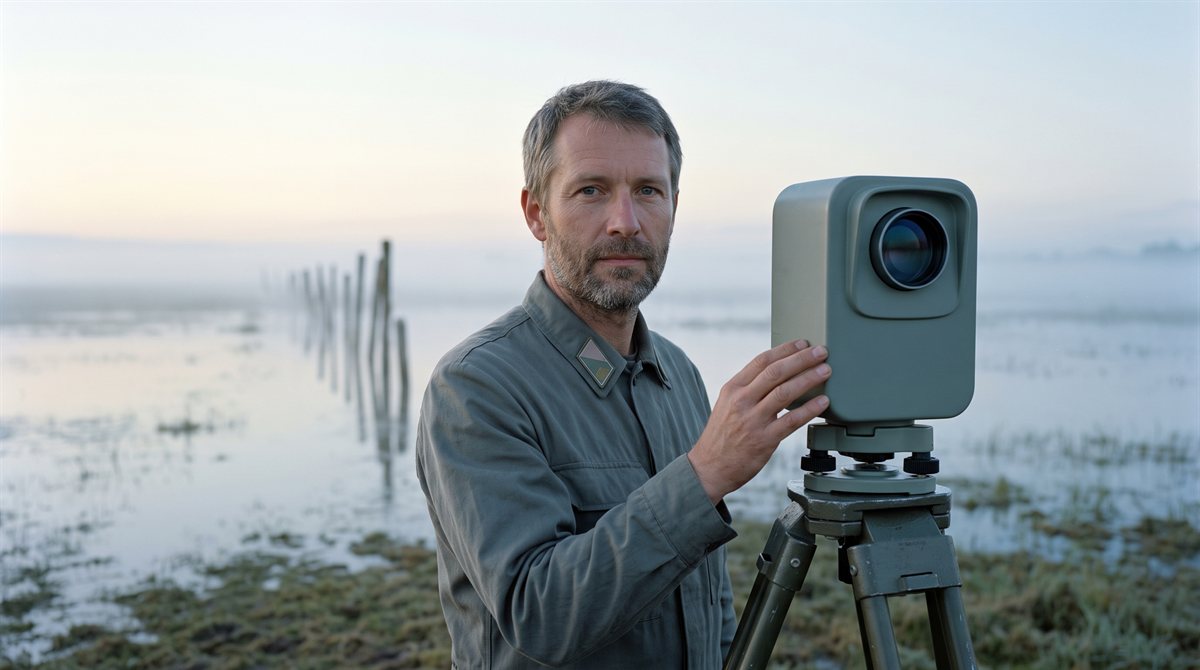
Sir Galahad Thorne (Human)
- Time
- 2826 UCSD, Early Winter, Dawn
- Location
- Pelagos Minor, Equatorial Evacuation Basin
The alarms on Pelagos Minor had a calm voice, and that was the first thing Galahad noticed when the Basin sirens began — not screaming, not the rising, jagged tone he'd braced for, but a clear directive repeated every twelve seconds over every public channel, level as a metronome: Priority boarding order: women. Then children. Then older adults. Hold your lane. Compliance preserves life.
He had heard harsher systems fail because they sounded like fear. This one sounded like procedure, and people listened to it the way people listen to something that has already decided not to lie to them.
The sky over the basin had split into three colours by the time he reached Corridor C: storm-green in the upper layer, iron-grey beneath it, and a low seam of copper where the atmospheric fault was cutting straight through the launch shields. Each shuttle lift looked temporary against mathematics that no longer liked the planet — improvised, insufficient, and going up anyway because insufficient was still better than nothing.
They moved people by category and scan-tag. No exceptions, and for the first several hours no visible cost either. Women boarded fast, in ordered files that held their shape even as the ground shook. Children went up in bundled clusters, sorted by a triage team that had clearly drilled for exactly this and never quite believed they'd need it. Older people were carried, wheeled, lifted, shouted forward through lanes that actually held their order under pressure that should have broken any queue Galahad had ever supervised.
He spent six hours in Corridor C keeping that order, because in Corridor C, order kept people alive. He watched men in their twenties and thirties pass children over their own shoulders to strangers, pass their place-marks to mothers who hadn't asked for them, pass water and air-filters hand to hand down a line, pass every argument they might have had about fairness — because arguing would slow the line, and slowing the line would kill everyone in it, including whoever was arguing.
When Corridor C collapsed, they rerouted. When Corridor B lost pressure an hour later, they rerouted again. When Corridor A failed close to the fourteenth hour, there was nowhere left to route to.
The final transport rose only half full, because the docking arm sheared before the crew could seal the aft ramp. Galahad watched the men who'd been queued for it running toward the ramp as it lifted anyway — not screaming, just running, the particular silent effort of people who seem to believe, for exactly as long as their legs are still moving, that effort alone might revise the physics happening above them. It didn't. He made himself keep watching until the transport cleared the shield line, because looking away first felt like a second abandonment layered on top of the one already happening, and he was not going to be the one who added that.
Afterward, in the temporary shelters above the floodline, people called the evacuation a success, because thirty-eight thousand people had lived through fourteen hours that should have killed most of them. Galahad signed the same report and used the same word. His hand was not steady when he wrote it, and he noticed that it wasn't, and he wrote the word anyway, because it was still the accurate one.
Success had a shape, once you stayed long enough to see it fully. The shelters ran queues for medicine, queues for food, queues for grief counselling — and in every one of those queues, Galahad started noticing the same pattern before anyone gave it a name: too many widows under forty, too many boys with no uncles left to answer the questions that come after the sirens finally stop. Nobody had designed this. Everybody had simply obeyed, in order, exactly as instructed, all the way to the end of the instructions. The result was no less real for having been nobody's intention.
Discussion
Show discussion
Comments are read after they are posted and anything unsuitable is removed. Posting needs a GitHub account; reading needs nothing.