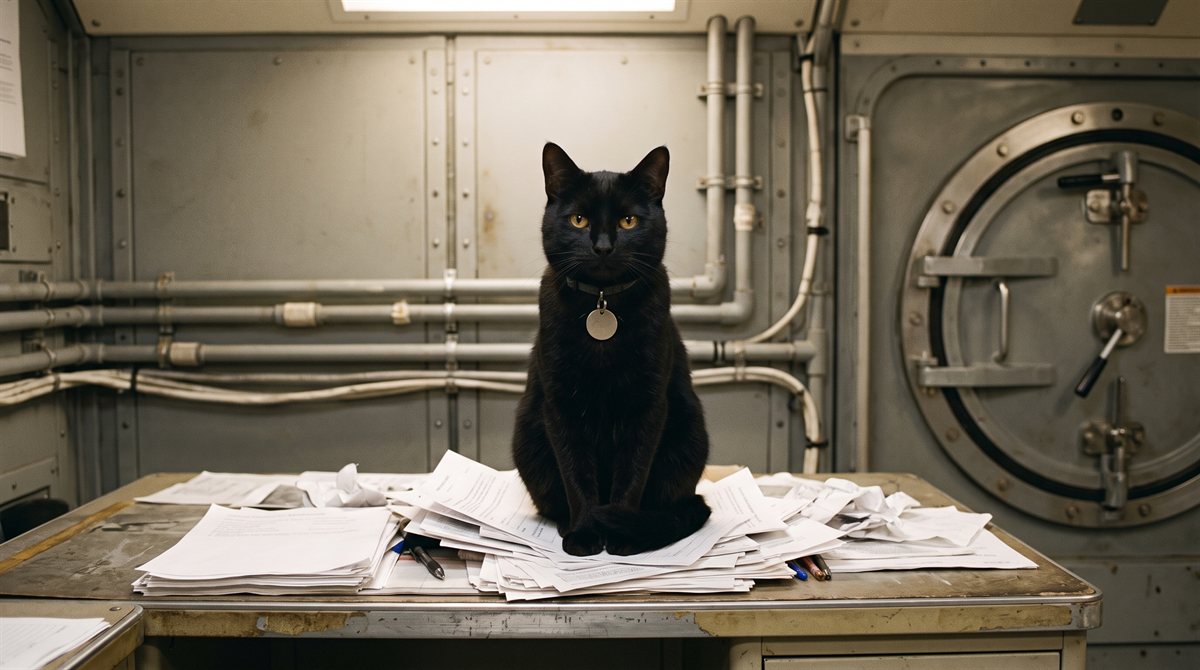
Agent Barsik (Cat, Smart Pet)
- Time
- 2826 UCSD, Early Winter
- Location
- Eden Space Habitat, Passage Oversight Deck and Deck 5 Service Tunnels
The agency's doctrine on reporting is two words long — filed, not volunteered — and the trainee had asked, reasonably, what the doctrine was for a finding that two different chains of command each owned half of.
The honest answer was that the doctrine had never anticipated the question, because the doctrine had never anticipated Eden, where a corridor could misbehave under one authority while its door misbehaved under another. So Barsik did what the agency does when doctrine runs out: he made the report exist in the places where the right readers already were, and let each half look like it had arrived by itself.
The corridor was the easy half. A run of tunnel that measured forty metres on some passes and forty-one on others, inside a habitat whose fold-adjacent clearances are the Passage oversight's to certify, was Safety Corps business the moment anyone with standing read it. The problem was getting it read. Eden's compliance framework had a documented digestion time of months, and the oversight's own queue was not much livelier — except for one desk. The recertification bundles for the Deck 5 environmental sensors crossed the rotation officer's desk weekly, and this rotation's officer read them. All of them. Annexes included. Barsik had confirmed this personally, from the top of a filing cabinet, over three consecutive weeks, because a plan that depends on somebody reading an annex is a plan that depends on a very rare kind of somebody. The survey extract went into the bundle as an unattributed instrument-anomaly annex, calibration certificate attached, and Barsik went back to the cabinet top to watch it land.
He knew a little about her, the way the station cat knows a little about everyone. New. Tír na nÓg, by the vowels. She had been on Eden before the uniform — a year on the dock circuit, one of the bands that played the loading bays — and dock-circuit people knew where the habitat breathed, which was more than could be said for most of the oversight's postings. And she was the only human on Eden who had never once tried to pet him. She said good evening instead, when they passed, in the tone one shift uses to another. He had no file that explained her, and had noted, in the file he was therefore obliged to open, that this was the most interesting thing about her.
The door was the other half, and the door was civil. A structure in a Compact tunnel, absent from Compact plans, was the detective bureau's to want — but the bureau could not be handed a survey by a cat, for reasons that were load-bearing to everything else the agency did on this station. So the door went in the other way: as a maintenance discrepancy, plans versus survey, door count fourteen versus door count fifteen, routed into the compliance queue that empties onto Detective Inspector Albercombe's desk — the queue whose referrals are famous for being exactly as boring as they read.
The trainee had questioned this too. Her point, filed with her usual economy, was that disguising a true report as a boring one seemed like the opposite of reporting. His answer went into her training log, because it was the closest thing to a first principle the Eden posting had: on this habitat, boring is the only classification that gets investigated by someone competent. Interesting goes to a committee.
Both copies landed inside a week. The trainee's follow-on exercise was to observe what a report does after it is filed — an exercise most agents never complete, because most reports do nothing, observably, forever. He did not tell her that. Some findings a trainee should have the pleasure of establishing herself.
Discussion
Show discussion
Comments are read after they are posted and anything unsuitable is removed. Posting needs a GitHub account; reading needs nothing.