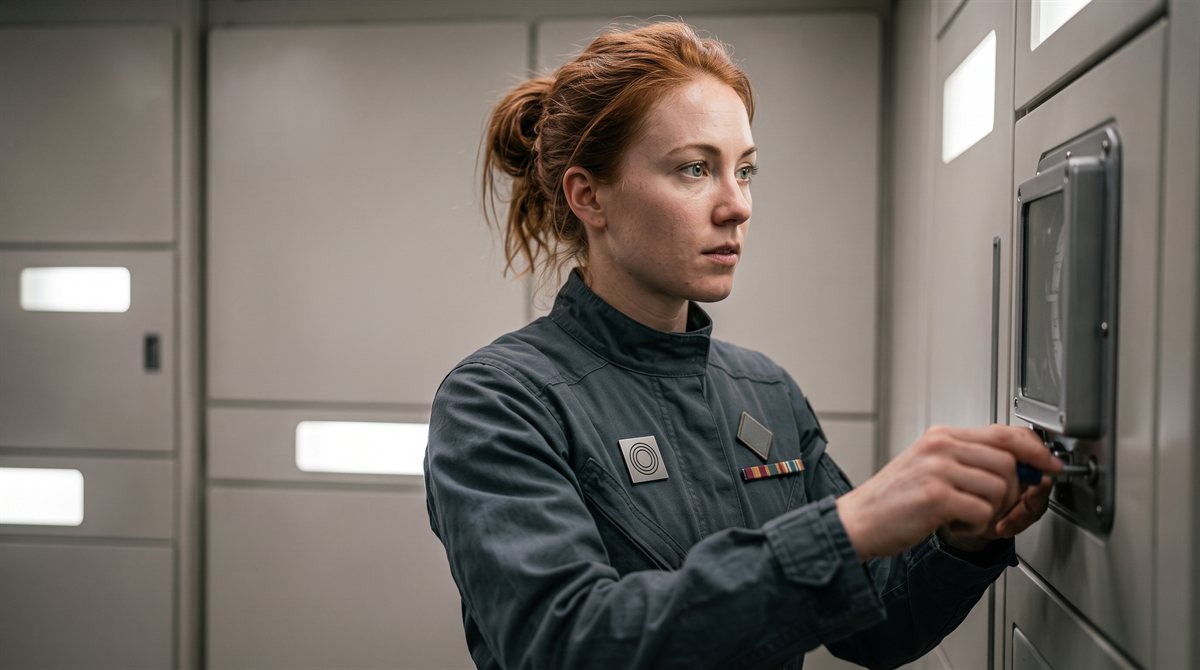
Officer Tissadelle Shepherd (Human)
- Time
- 2826 UCSD, Early Winter
- Location
- Eden Space Habitat, Passage Oversight Deck and Deck 5 Service Tunnels
Testing, Inspection and Certification. The rotation's whole vocabulary was three nouns, and Officer Shepherd had signed for all three of them, which is how the Safety Corps phrases the fact that it has not signed you for anything else.
She had taken the rotation because it was offered and because turning down a corps posting two months into a new rank was not a habit worth forming — and, privately, because it was Eden, and she had spent a year of her life in this habitat's loading bays learning which decks kept their promises, and some part of her had wanted to see it again from inside a uniform. The work itself was checklists. Torque a sensor mounting, swap a reference cell, sign. She did the checklists properly, the way she did everything properly, and read the bundles all the way through, annexes included, because an annex is where a bundle keeps the things nobody wanted in the summary.
Which is how she met the corridor.
Two lengths, one run of Deck 5 tunnel, both readings stamped valid by an instrument whose calibration certificate arrived already attached — attached before anyone could ask for it, by a filer who had plainly known exactly how instrument reports die on this station and had built this one to survive the process. She read the annex three times. Her training said several things about it, and the difficulty was which training.
She had been most of the way to a different uniform once. The Gardaí, on Tír na nÓg — she'd finished the coursework, passed the boards, stood two weeks short of the oath, and then left, for reasons that had felt at the time more like the pull of the sky than the push of anything on the ground. What the training left behind hadn't demobilised just because she had: evidence chains, interview discipline, and the one lesson her instructors there and her instructors since had agreed on without ever meeting — that the difference between what you know and what you can show is not a gap in the job, it is the job. A filer who pre-attaches the calibration certificate knows that lesson. That was not an instrument reading. That was a witness statement built to survive cross-examination, and she wanted, with an old and specific hunger, to know who on this station built those.
Her remit was three nouns. But nobody had ever written a regulation forbidding a certification officer from measuring a corridor, because nobody had ever needed to. Measuring corridors is the job. She drew a certified laser gauge from stores, logged it out properly, walked the run, and got forty metres. Walked it again after the next spoke transit and got forty-one. Both readings valid. Both instruments in certification. She filed it as exactly what her signature was good for — instrument disagreement in fold-adjacent clearance space, environmental re-survey recommended — one page, no theory, nothing she couldn't show. The Gardaí would have graded it well. So, probably, would whoever filed the annex.
The bureau's liaison request arrived two days later, about a door, with the same survey attached, and she recognised the hand the way you recognise handwriting: precise, disinterested, correct, and signed by nobody. She read the request's actual question — which authority owns the far side of the frame — and understood that she could answer it from her desk, from the registry, in an hour, and that she was not going to, because the registry did not hold the door and she wanted to see it.
Officially: an inspection. She logged it as one, and it even was one.
Detective Inspector Albercombe was already in the tunnel when she got there, a slate under his arm with the bureau's intelligence riding on it, and he looked at her uniform the way civil police look at Rangers, which she had been on the other side of often enough to find nearly nostalgic. "This is a civil matter, Officer," he said, not unkindly, in the voice of a man performing a jurisdictional objection he intends to lose.
"The near side is," she said. "The far side of that frame is Passage oversight, which makes half this doorway mine to inspect. I'm not investigating, Inspector. I'm inspecting. The difference is which form I fill in afterwards."
He studied her for a moment. "You've done doors before."
"Trained for it. Different force, different planet."
"Which?"
"The Gardaí. Tír na nÓg. I left before the oath."
"Why?" It was a real question, asked the way career police ask it, from professional curiosity about anyone who almost was one.
She gave him the honest answer, which she had never once managed to make sound like less than it was: "I wanted the part of the job that happens before anything goes wrong."
What they established, jointly, in an hour of him not conceding it was joint: the door was real, kept, and used — hinges maintained, seals renewed, opened within the last cycle. To go further, his chain needed a warrant naming a door his own habitat's registry insisted did not exist, and her chain needed an exceedance finding against a structure absent from the register her corps certified against. Two authorities, one frame, and the paperwork of each contingent on the other's going first. Albercombe said a word civil police say in every jurisdiction, on every planet. She wrote, in the inspection log, access pending joint instrument, which was the same word with the serial numbers filed off.
Her one-page corridor finding, it turned out, was the key that fit: an uncertified environment reading two lengths was grounds for the oversight to order the re-survey, and a re-survey's scope could lawfully include every structure on the arc, listed or not. She drafted the request that evening, narrow as a blade, nothing in it she couldn't show. The shadowing she did not log, because observing a bureau interview two decks up — the plans office, a reconciliation clerk, forty years of signatures to account for — was not testing, was not inspection, and was not certification, and she stood at the back of it anyway, silent, learning Eden's version of a craft she'd walked away from two weeks short of an oath, and finding she had missed it the way you miss a language.
On the way up she passed the station cat, sitting on the rail-bed barrier as though the barrier answered to him, watching the tunnel mouth with the settled attention of a colleague reading a closed case file. "Good evening," she said, because she always did. Tobble, who had spent the whole day being professionally quiet while she worked, remarked that the cat was on shift. She didn't ask what he meant by it. Some assessments you don't volunteer until you can support them — and she was no longer entirely sure, since the second measurement, that anything on this station was only what its paperwork said it was.
Discussion
Show discussion
Comments are read after they are posted and anything unsuitable is removed. Posting needs a GitHub account; reading needs nothing.