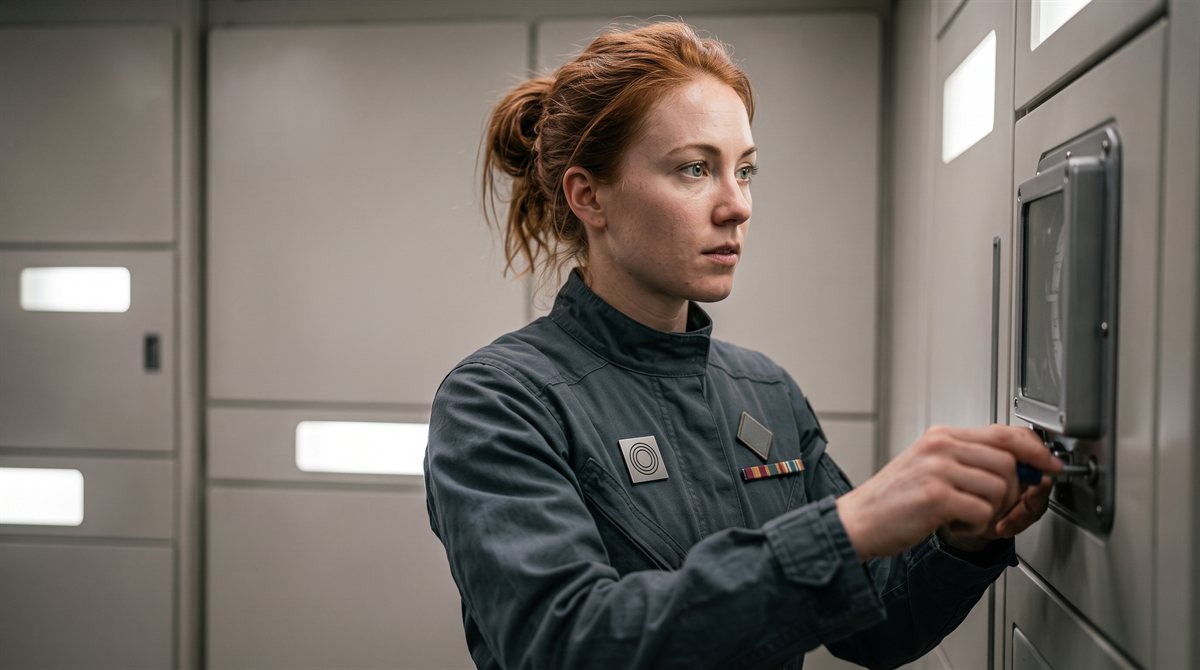
Section Lead Tissadelle Shepherd (Human)
- Time
- 2828 UCSD, Summer
- Location
- Threshold Station, Boundary Operations Room
The room wanted a point, and she had a band.
Threshold had been logging the oscillation for thirteen years, since a chronometer disagreed with itself by forty seconds and a Survey office decided that the disagreement was the symptom and not the fault. Thirteen years of boundary readings had given the oscillation a shape, and the shape had edges, and inside the edges the thing moved as it liked. Shepherd had read all thirteen years in her first week back on general operations, because the transit windows were a Section Lead's to state and she would not state one she had not read the ground of. What the readings supported was a band: a transit begun inside it would cross the boundary while the boundary was where the corridor assumed it was, to a tolerance the pilot section had flown before. What they did not support was the forty minutes narrower than the band that the room would have liked, because forty minutes narrower was a window the station's traffic plan had been built around before anyone had asked whether the oscillation agreed.
She said so. She said it in the form she had learned to say things in, which was the form that could be checked: the band, its edges, the readings that put the edges there, and the sentence that the readings did not support a narrower window and she would not state one.
The officer presiding, a Starwarden, was not unreasonable. He wanted a point because a point was what the traffic plan took, and he said that a Section Lead who had just come off two years on the Survey track might, with respect, be reading a boundary like a survey and not like a corridor, and that the corridor had been flown on the forty-minute window for eleven years without incident, and did she have a reason to think it would not be flown on it again.
She did not have a reason. She had a band. That was the whole of what she had, and she had learned in a review chamber in the spring that the whole of what you had was the only thing worth standing on, and that standing on it was something you did in silence, because the moment you argued for it you were adding something you did not have. So she stood on it. She said that eleven years without incident was a fact about eleven years and not about the readings, which was true, and then she did not say anything else, and the room waited to see whether she would be made to.
Chief Pilot Wender was at the end of the table.
Shepherd had noticed her there the way one notices that it has started to rain. A Chief Pilot does not come to a transit briefing; a Chief Pilot's section flies what the briefing states and sends a deputy to hear it stated. Wender had come. She had said nothing for the forty minutes the briefing had run, and had looked at the readings when they were put up and at nothing in particular when they were not, and Shepherd, who had been aware of her as a cadet is aware of weather — a condition, a rank, a horizon — had not until this minute had cause to wonder what the weather was doing in the room.
The Starwarden asked the pilot section, as the Starwarden was entitled to, whether the forty-minute window was flyable.
"The section flies the window as it is stated," Wender said. She did not look at Shepherd. "If the Section Lead states a band, the section flies the band. If she states a point, the section flies the point." A pause, of the kind that is not a hesitation. "The section does not fly as a point what it was given as a band. That is not a thing I can order flown."
It was not an endorsement. Shepherd heard that, and heard that it had been built not to be one: it said nothing about the readings, nothing about whether a band was right, nothing about her. It said what the pilot section could execute and what it could not, which was the one thing in the room a Chief Pilot had unarguable standing to say, and it left the Section Lead's statement standing exactly where the Section Lead had put it, unargued-for. The Starwarden took the band. The traffic plan would be rewritten, which was a cost, and he said so, and it was noted.
Afterwards, in the corridor, Shepherd counted.
A Survey certification board the autumn before last, when she was a Senior, where a Chief Pilot had sat in on a question about telemetry that touched no corridor at all. A hand-over in the winter after it, when the Hegemony backlog came to her as a new Principal, where the pilot section had no interest and its Chief had been, Shepherd now recalled, by the door. And today. Three rooms, none of which had required her, in each of which she had said less than anyone, and the saying less had a shape — the shape of a person leaving a thing exactly where its owner had put it.
Shepherd did not know what to do with that, so she did what she did with everything she could not support, which was nothing, and filed it where she filed those things, and went to rewrite the window.
Discussion
Show discussion
Comments are read after they are posted and anything unsuitable is removed. Posting needs a GitHub account; reading needs nothing.