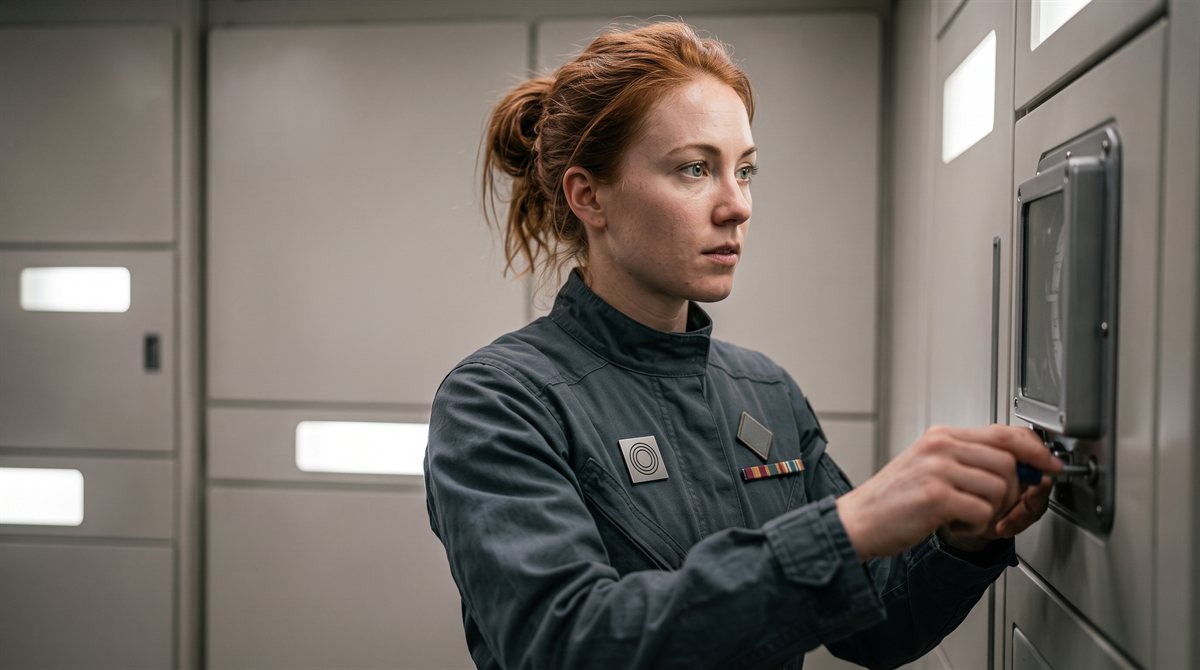
Line Captain Tissadelle Shepherd (Human)
- Time
- 2831 UCSD, Early Autumn — Afternoon Arrival Through Morning Departure
- Location
- Tír na nÓg, Boirinn Uplands — the Shepherd holding, then the Union shuttle gate
The data cache changed hands at the council house in under four minutes. Tissadelle had expected longer — some ceremony to match the weight the Union's mediation council put on the standing agreement — but the clerk who received it treated the exchange exactly the way Threshold Station's own archivists treated any transfer: verify the seal, log the timestamp, sign for custody. She approved of that more than she expected to.
Everything after the council house was personal leave, logged as such, and she was careful about the distinction the way she was careful about most things. The Rangers had no jurisdiction on Tír na nÓg. They had an invitation, narrowly worded, covering one exchange of survey data on boundary-zone matters. Whatever she did once she was walking the uplands in her own coat instead of her service one, she did as her mother's daughter, not as a Line Captain. She had said this to herself twice on the transit down, which was usually a sign she didn't fully believe it yet.
The uplands smelled the way they always had — wet stone, cut gorse, the particular sweetness of the pale lowland flowers gone to seed. Her mother talked the whole climb, the way she always had, about the flock, about a cousin's dispute over grazing rights, about nothing that required an answer. Tissadelle listened with half her attention and catalogued the rest of it out of a habit four years deep: wind direction, ground moisture, the two ewes favoring their left forelegs.
She noticed the trees before she understood why she'd noticed them.
They stood in a shallow fold behind the home pasture, pale-barked, the leaves moving a half-beat behind the wind that moved everything else. She had read that exact description in a Survey Corps bulletin eighteen months ago, filed under Marsh Causeway flora, and had not thought about it since. She stopped walking.
"That's the Hollow," her mother said, not stopping. "You don't go in past dusk. You know that."
"I know the rule," Tissadelle said. "I didn't know why it was the rule."
Her mother looked back at her then, and Tissadelle understood — with the specific, unwelcome clarity of a hypothesis confirming itself — that she was no longer looking at this hillside the way she had left it. She was reading it. Bark chemistry, root geometry, a rule that had kept a family safe for longer than anyone here had a name for the reason. She could file this. She had the vocabulary, the classification, half a report already assembling itself in her head.
She also had no authority to write it. And, standing in her mother's back field with her mother's face waiting for an answer, she found she did not want the report. She wanted to tell her mother what the rule meant, plainly, as family — which was a different act entirely, and one the charter had never needed to forbid her, because it had never occurred to anyone drafting it that a Ranger might come home.
Discussion
Show discussion
Comments are read after they are posted and anything unsuitable is removed. Posting needs a GitHub account; reading needs nothing.