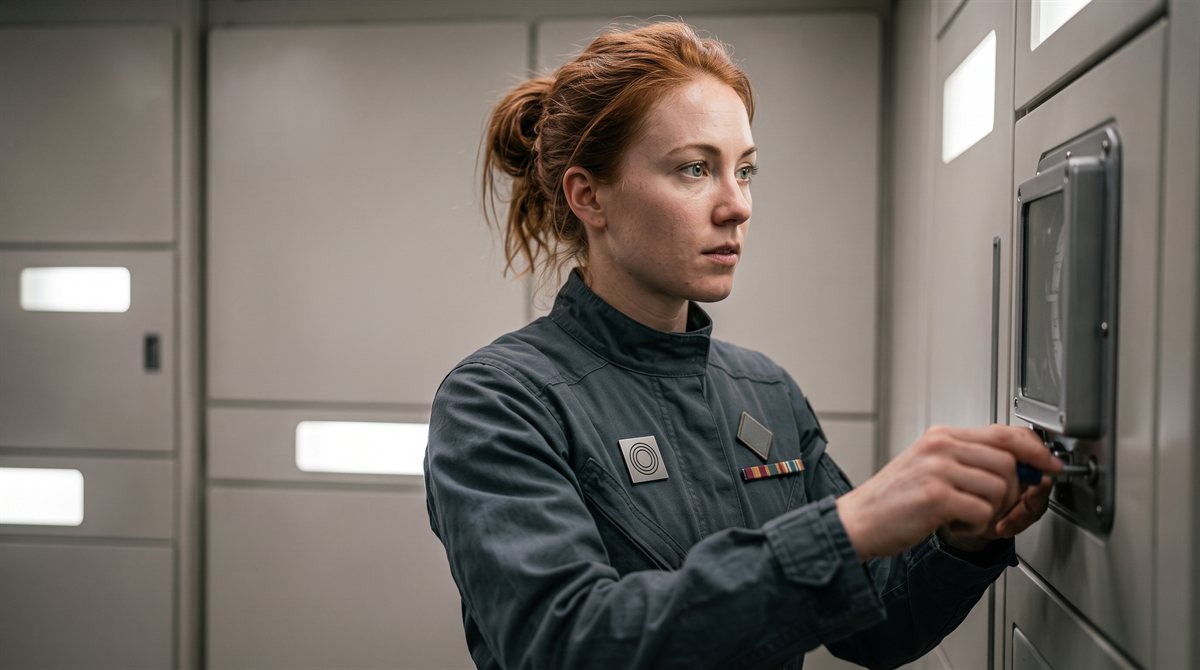
Line Captain Tissadelle Shepherd (Human)
- Time
- Indeterminate. She has stopped trusting the count.
- Location
- The Boirinn Uplands, recursing
She ran the diagnostic she would have run on any anomaly, because she was the anomaly and there was no one else to run it.
State the marker. State whether it resolves.
The marker was the morning on the hill. She had it now more times than she could hold: the grey, the gold, the flock, her mother at the door with you're up early. She had counted, before the count stopped being a number she could keep, and it had happened at least nine times and possibly ninety, each one entire, each one true, and — this was the finding — each one ending a little differently. Once her mother said you're up early and once she said you've been gone too long and once she said nothing at all and only put the kettle on, and Tissadelle could not order them. There was no first. A real morning had a first. This one had a stack of firsts, all claiming the position, none of them yielding it.
Does it resolve.
It did not resolve. That was the whole finding and it was the finding she had spent a career trusting: a signal that never resolves, however rich, is not a record of something that happened once. It is a loop. She had taught this station that its unclassifiable pulse was not noise. She made herself finish the sentence honestly, in the flat voice, the only tool she had brought with her into wherever this was: and I have taught myself, now, that my homecoming is not a memory. It is a thing I am doing. I am doing it because I have nothing else to do it with.
She understood, standing in a clearing that could not decide how far it was from the house, precisely what she was. She had read the lore under other names, in briefings that had cost her nothing to sit through. A mind past saturation and short of crystallization. Enough interior structure to keep generating a self. No external grounding. No confirmation that the process she was inside of would ever complete, or that "complete" was survival rather than the end of her. A seed that had not finished becoming, building a world out of the only wanting it had left — the Uplands, the Hollow, her mother, and, when she let herself, Wender — because that material was load-bearing and there was no other kind left to bear the load.
She named it, flatly, before anyone outside could name it for her, because naming a thing you can't yet fix is still the only honest first move. I am a stalled seed, and I believe I am trapped inside my own inner world, and I believe that because it is true.
And then, at the edge of the clearing — past the second false position of the Hollow, past the place the hillside kept offering twice — something that was not part of her world stood where her world ended, and did not come in.
She felt it before she could look at it, the way you feel the pressure change before a storm you can't yet see. It was folded into the air in a way the air did not tear to allow. It was at the edge and it was, somehow, at every distance from her at once, near and far being categories it declined to sort itself into. She had grown up on the story of exactly this. Every child of the Union charter worlds had. A shape too great for a clearing to hold, and yet the clearing held it; a presence a thirteenth-century woman had taken for a saint and then, being honest, refused to fully call one.
Aoife of the thorn well had written — had let it be written — that she'd been shown, not healed, and had kept the two apart even when collapsing them would have been easier for everyone including herself. Tissadelle had never had much use for the devotion. She had considerable use, now, for the discipline underneath it.
The thing at the edge of her world did not enter. It did not fix her. It did not tell her the recursion was a memory or that the morning had a first after all. It stayed at the boundary of the only reality she had, and it held there, and the holding said, more clearly than a voice could have: I am not going to complete this for you. I am going to stay at the edge so that you are not doing it alone.
The clearing, where the presence touched its edge, ran warm.
Discussion
Show discussion
Comments are read after they are posted and anything unsuitable is removed. Posting needs a GitHub account; reading needs nothing.