Callisto Station
Ligeia is a station that became a home. Callisto is one that never did, and was never meant to.
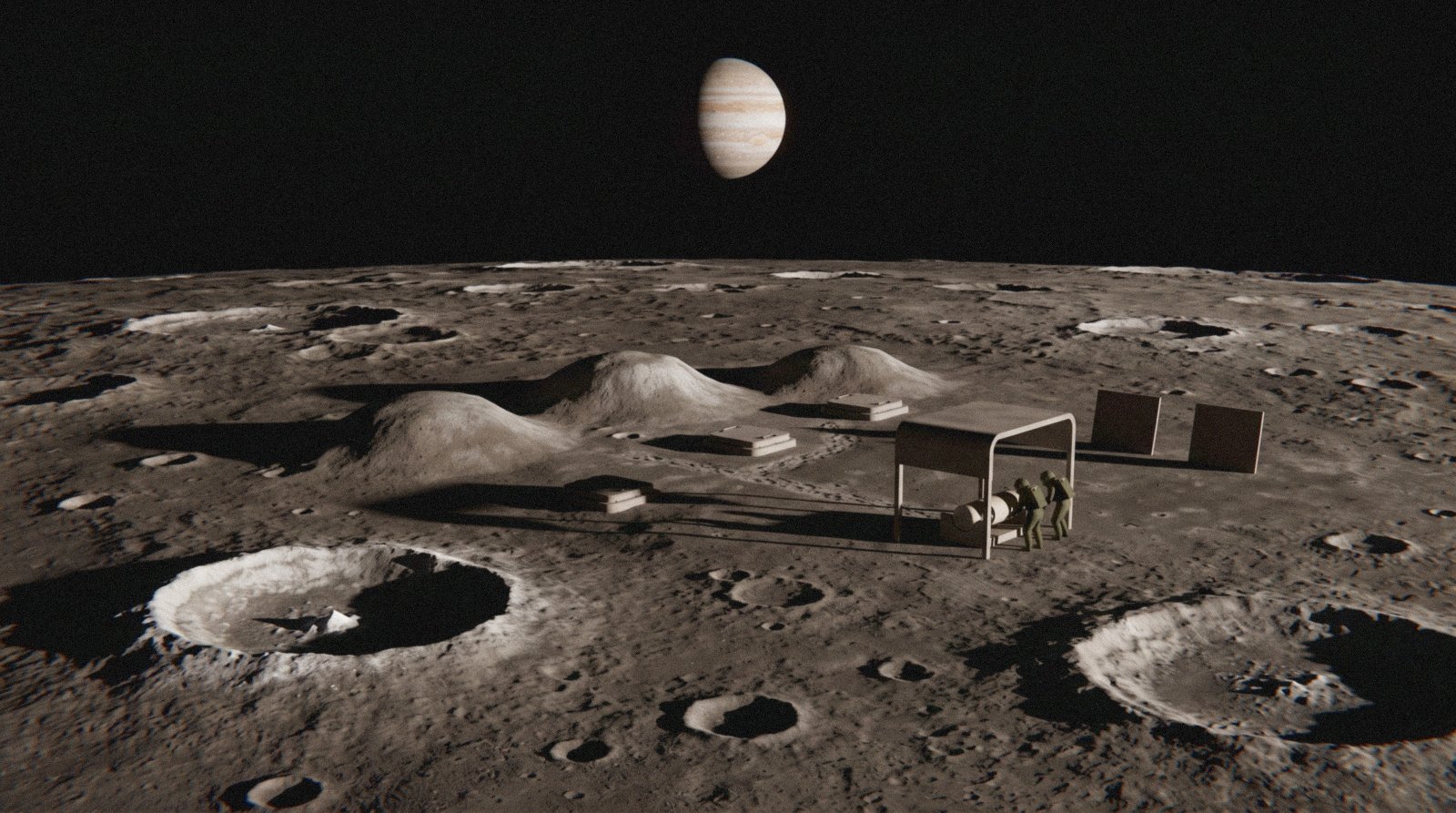
Callisto Station is a Star Rangers Survey Corps post on the surface of Callisto, the outermost of Jupiter's four large moons. It is the depot for the Corps' standing survey of Jupiter's Lagrange points and the base from which the Planetology Branch reads the Jovian moons from outside the radiation that guards them. It is crewed by Rangers and contractors on postings of months, and it sits on the near side of the habitat threshold: an installation, not a polity, and so the Corps' own ground. A signal between Callisto and Earth takes between about thirty-five and fifty minutes each way.
Why Nobody Settled Jupiter
The Solar System's first settlement networks went to Mars, the Belt and Titan, and passed Jupiter by. The record's reading is that Jupiter's system offered nothing those three did not offer more cheaply. Its inner moons sit inside radiation that would kill an unshielded person within days on Europa and within weeks on Ganymede. Callisto lies outside the worst of it, but it is a battered ball of ice and rock with next to no atmosphere, with nothing to draw on that the Belt's ice haulers were not already selling, and none of the nitrogen that made Titan worth the extra distance.
So Jupiter had no settlers to fight for in the Coherence Wars, and none to punish afterwards.
Outer Administration Station One
The Imperium built it anyway. When the outer station network was rebuilt after the Tycho Accords of 2543 UCSD, the first post in the chain went to Callisto, entered on Imperium registers as Outer Administration Station One. It was not there to govern anyone. It watched traffic: the routes between the Belt and Saturn cross Jupiter's distance from the Sun, and a patrol post on solid ice outside the radiation could see them pass. It was dug into the moon's crust rather than set in orbit, because metres of ice are the cheapest shielding there is, and its crews rotated in from the inner system.
At the restructuring of 2609 UCSD, the outer stations with civil populations under them passed to those populations, as Station Four did to Titan's and became Ligeia. Station One had nobody under it. The Military Space Command kept it as a patrol post for another century, and it was still entered as Station One when the Consolidation Accords ended the patrols. Nobody has renamed it since. Its crews call it One, and the Corps calls it Callisto Station in correspondence, and both names stand on the same register entry.
The Late Survey
The discovery of the Eden Passage in 2712 UCSD showed that Lagrange geometry is one of the strongest indicators that a natural fold route may exist. The record says plainly that this should have prompted an immediate systematic survey of the Solar System's L4 and L5 points, and that it came late. Callisto Station is where the late survey's outer half is run from.
Jupiter's L4 and L5 points, sixty degrees ahead of the planet and sixty behind, hold two great swarms of small bodies, the Trojans. Each swarm is as far from Jupiter as Jupiter is from the Sun, so no base near the planet is close to either; but Callisto is the same distance from both, it has ice to make reaction mass and air from, and it is the nearest solid ground outside the radiation. The station builds, calibrates and services long-baseline instrument buoys, and its survey craft carry them out to the two swarms on voyages measured in months.
The survey has not confirmed a natural fold route at either point. It has not ruled one out either, and the Corps files the absence that way: as a measurement still running, not a finding.
Life on One
Callisto's gravity is about an eighth of Earth's, and nobody stays long enough for it to matter. A posting is a few months; the crew live under the ice in plain corridors cut and lined against it, and the work is instrument benches, buoy cradles and the long quiet of craft that will not be back until next season. There are no families aboard, and no school, court or council. That is the whole of what keeps Callisto below the threshold, and it is the same physics that put Ligeia above it, read the other way: where Titan's families went up to the ring to raise their children at full weight, nobody has ever brought a child to Callisto at all.
Callisto keeps one face to Jupiter, and the station stands on that face. The planet hangs in the black sky over the surface hatches, about eight times the width of a full Moon seen from Earth, and never rises or sets. New postings are told on arrival that they will stop noticing it within a week. Most of them say afterwards that they did not.
See also: Ligeia Habitat, Lagrange Points and Fold-Space Transit, Habitat Threshold, The Star Rangers Survey Corps, The Imperium, Titan, Eden Space Habitat.
Discussion
Show discussion
Comments are read after they are posted and anything unsuitable is removed. Posting needs a GitHub account; reading needs nothing.