Ligeia Habitat
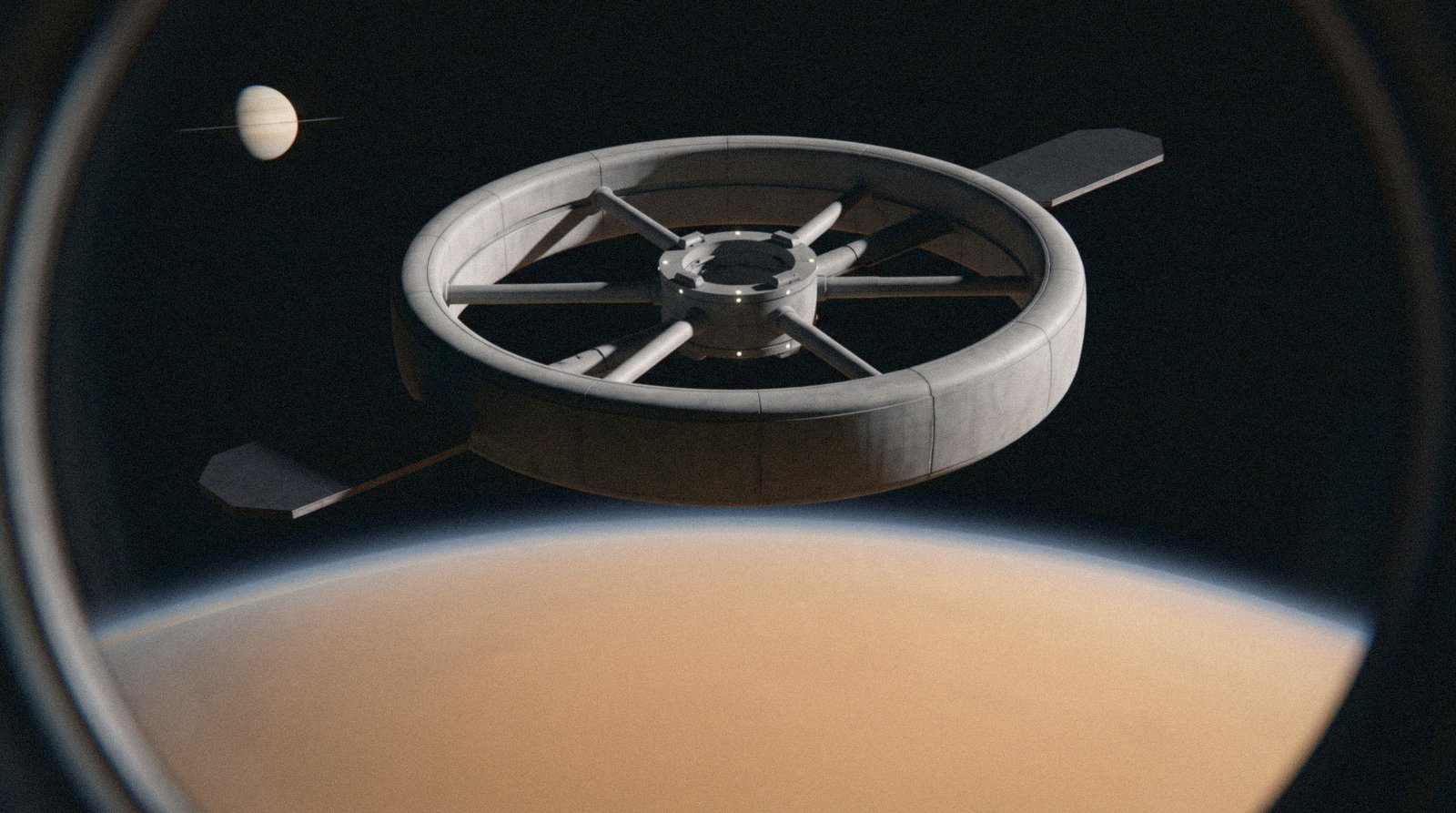
Most habitats were built for the people who live in them. Ligeia was built to watch them, and they moved in anyway.
Ligeia is a self-governing habitat in high orbit around Titan, Saturn's largest moon, roughly nine and a half times Earth's distance from the Sun. It is the seat of the Titan Settlement Authority, which governs the habitat and the stations on Titan's surface under one charter, and it is the only settlement beyond the Belt that the Archive knows to stand above the habitat threshold. A signal between Ligeia and Earth takes between about seventy and ninety minutes each way, depending on where the two planets stand in their orbits.
Titan Before the Ring
People have lived on Titan since the first permanent settlement networks of the 2140s CE (2340s UCSD), when Titan stood with Mars and the Belt as one of the three settled regions whose delegates founded the United Space Consortium. Titan offered what almost nothing else in the outer system does: a thick nitrogen atmosphere at about one and a half times Earth's surface pressure, lakes and seas of liquid methane and ethane, and a crust of water ice over a deeper ocean. It was a cold world — around ninety-four kelvin at the surface — but a generous one, and its settlers worked it from sealed stations on the ground.
The Titan Settlement Authority was the government those stations formed. In 2289 CE (2489 UCSD), after a decade of Consortium negotiation over the extraction of Titan's subsurface ice had produced nothing, the Authority acted alone. That unilateral act was the precipitating crisis of the Consortium's collapse: three other constituencies declared it illegal, counter-declarations followed, and fourteen years later the Coherence Wars began.
The Authority has never changed its name. Its own register explains why in one line, enrolled beside the charter in the first years after the Imperium: a body that renamed itself would be asking to be judged as someone else.
Built to Watch
The ring itself is two centuries younger than the settlement. After the Tycho Accords of 2543 UCSD, the Imperium rebuilt the outer station network as part of a settlement policy that was punitive for two generations and restrictive after that. The station it set in orbit around Titan was an administrative and patrol post, entered on Imperium registers as Outer Administration Station Four; the first of the chain, Station One, is Callisto Station. It was built to full spin gravity because its crews rotated in from the inner system and the Imperium saw no reason to weaken them.
When the Imperium gave way to the Military Space Command in 2609 UCSD, the station's administration passed to Titan's civil government. The record of the negotiated restructuring lists it among the matters the outer-station representatives on the High Council raised, and does not say whether it was conceded or simply no longer wanted.
The Authority named it Ligeia, after Ligeia Mare, the methane sea on whose shore many of its founding families had worked, at Stillwater and the stations that followed it. The old designation was not struck. It stands on the Authority's register as the station's first entry, with the renaming enrolled beside it, which is how the enrolled text of settled space keeps every change and why the habitat's name answers to a date.
The Right Weight
What turned an administrative post into a home was gravity. Titan's surface gravity is about a seventh of Earth's. What growing up at a seventh of Earth's weight does to a human body over a lifetime is not something the record establishes, and the Authority decided early that it would not find out by raising its own children there. Within a generation of the handover, families working on Titan were keeping their homes on Ligeia, whose ring turns at full Earth weight, and travelling down to the surface on rotation.
That is the reverse of the usual arrangement. Elsewhere a crew rotates to a station and lives on the ground; on Titan the crews rotate to the ground and live on the station. Ligeia passed the habitat threshold for that reason and no other: nobody aboard was trying to put a line between themselves and anyone else's authority, but enough people stopped intending to leave.
Travel between the ring and the surface is by ascent javelin going up and landing craft coming down. Titan's low gravity and deep atmosphere make both unusually easy; a landing craft can lose most of its speed in the air before it needs its engines at all.
The Standing Notice
The Authority's best-known law was written after the Imperium, and it is about 2289.
No act of the Titan Settlement Authority that binds anyone outside it takes effect until it has been delivered to those it binds and forty days have passed. A tariff, a change to a traffic clearance, a new limit on what may be drawn from Titan's seas or ice, a withdrawal from an agreement — each is posted in full to every party it touches, and the period runs before the act can be applied to them. The forty days are long enough for an objection to make the round trip to any settled body in the Solar System and be answered, and the Authority must enrol each objection it receives, with its answer, beside the act.
The notice does not give a neighbour a veto, and was never meant to. What it removes is the possibility of acting before anyone affected can speak. The register does not describe it as an apology, and the Authority's own commentary does not either. It describes it as the one thing the Authority could do in 2289 that it can no longer do.
Ligeia Now
Ligeia is a polity above the threshold, so the Star Rangers enter only by invitation, and its relations with its neighbours run through agreements rather than through any shared administration. It belongs neither to the Orbital Habitats Compact nor to the Knarr Line's Thing, and subscribes to the Solar System's compact in its own name.
Its trade is nitrogen. Every habitat in settled space loses some air over the years through docking, venting and repair, and the gas that has to be replaced is mostly nitrogen, which the Belt's rock and ice hold very little of. Titan's atmosphere is the most accessible reservoir of it in the outer system. Knarr Line convoys carry Titan nitrogen inward to the Belt, and a share of the air aboard most Belt habitats was, at some point, drawn down from Titan's sky.
Life aboard runs on two calendars at once: the Authority's civil year, kept in UCSD like every other record, and Titan's own day of almost sixteen Earth days, by which the surface rotations are scheduled. Children grow up knowing which of their relatives are down and when they will be back up.
See also: The United Space Consortium, The Imperium, Habitat Threshold, The Enrolled Text, The Knarr Line, Knarrheim, Eden Space Habitat, The Tally.
Discussion
Show discussion
Comments are read after they are posted and anything unsuitable is removed. Posting needs a GitHub account; reading needs nothing.