Titan
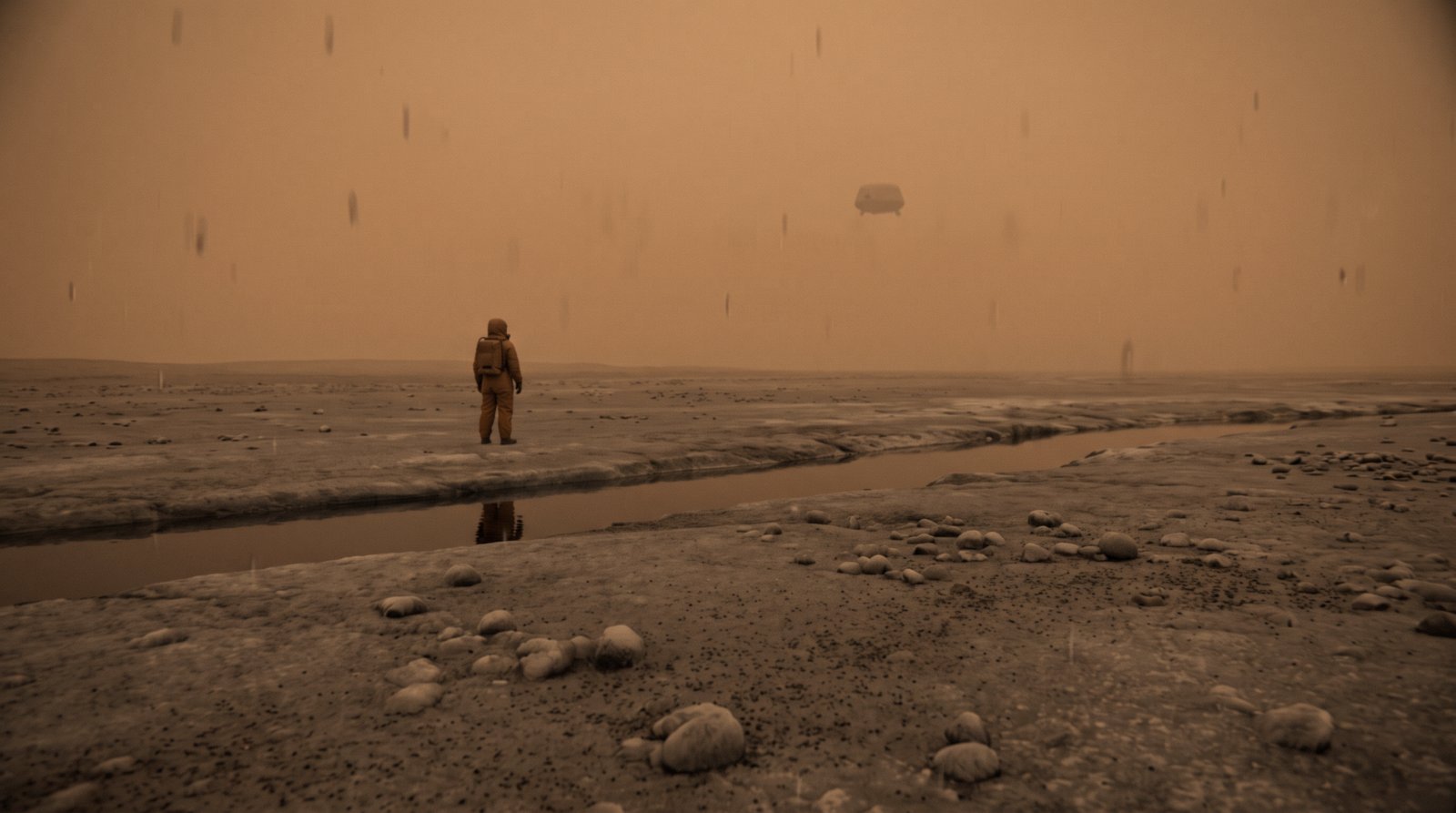
Titan is the only world in the outer Solar System where a person can stand outside without a pressure suit. They will still need heavy insulation against the cold, and air they brought with them.
Titan is the largest moon of Saturn, slightly larger than the planet Mercury, and the oldest settled world beyond the Belt. It has been worked from sealed surface stations since the first permanent settlement networks of the 2140s CE (2340s UCSD), and it is governed, together with the habitat Ligeia in orbit above it, by the Titan Settlement Authority.
The World
Titan's atmosphere is nitrogen, with a few percent methane, at about one and a half times Earth's surface pressure. Under a seventh of Earth's gravity that makes a column of air roughly ten times as massive, square metre for square metre, as the one over Earth's surface, which is why the ground is well shielded from radiation and why the sky never clears. A haze of hydrocarbons fills the upper air, and noon on Titan is a dim orange twilight: sunlight at Saturn's distance is about a hundredth of what reaches Earth, and the haze takes most of what is left.
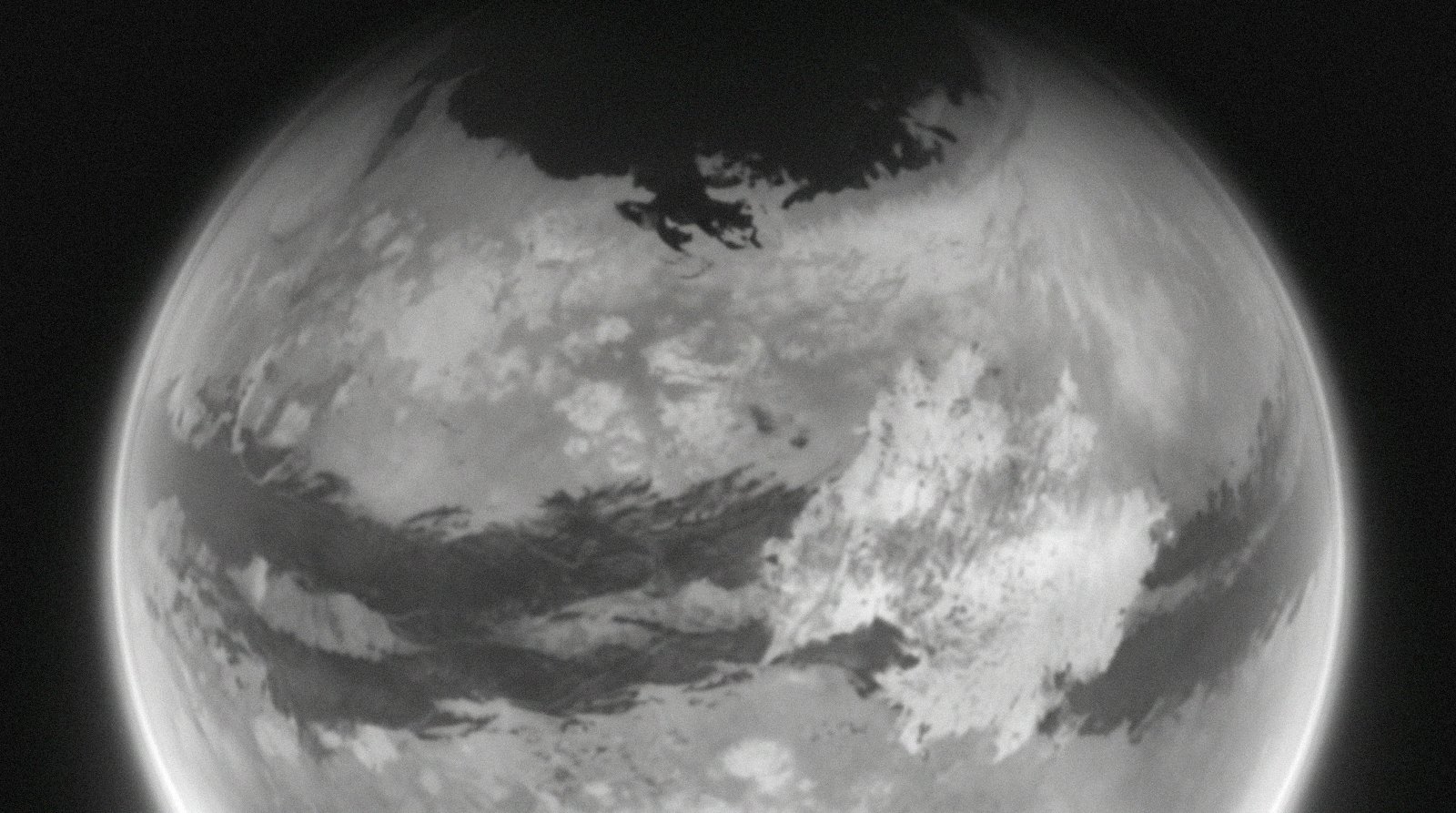
The surface stands at about ninety-four kelvin. At that temperature water ice is the bedrock, as hard as stone, and methane and ethane are the liquids. They fall as rain in large, slow drops, carve river channels, and fill lakes and seas around the north pole, the largest of them broad enough to have horizons. The low dunes that girdle the equator are not sand but grains of frozen organic material settled out of the haze.
Titan turns once on its axis for each orbit of Saturn, so its day lasts almost sixteen Earth days. Saturn, if anyone could see it through the haze, would hang fixed in the sky of the near hemisphere and never rise on the far one.
Below the crust of ice, the record holds, there is an ocean of liquid water. It has never been opened.
Working the Surface
Everything that makes Titan hard to live on comes down to cold and dark. Habitats are insulated rather than pressurised against vacuum, so a breach is a slow leak and not a blowout, but every structure has to keep its heat to itself and every material has to be chosen for a temperature at which ordinary steels and plastics shatter. There is no solar power worth the name. The stations have run on fusion from their first day, which the Fusion Ceiling treats as the ordinary case and Titan never questioned.
What Titan gives back is everything else. Water ice is the ground, and splitting it yields oxygen and hydrogen. Methane and ethane are feedstock for every plastic and polymer a station uses. Nitrogen is the sky, and it is Titan's export: the Belt's rock and ice hold very little of it, and the air lost from any habitat over the years is mostly nitrogen that has to be replaced.
The hazard the stations are built around runs the other way from most places. Outside there is fuel and no oxygen, so nothing burns. Inside there is oxygen, and the danger is methane seeping in from the ground. The oldest of the stations, Stillwater on the shore of Ligeia Mare, has been worked this way since the 2130s CE. Station safety on Titan is chiefly a matter of seals and gas monitors, and children on Ligeia learn the sound of a methane alarm before they learn their way down.
Getting to the surface and off it is easier than almost anywhere else that is settled. A landing craft loses most of its speed in the deep atmosphere before it needs its engines, and an ascent javelin climbing out of a seventh of Earth's gravity has a short, cheap climb.
Ice and Authority
The settlers' first government was the Titan Settlement Authority, and its first political crisis was over the ground itself. The Titan Water Rights dispute concerned the extraction of Titan's subsurface ice: who could draw on it, how much, and for which markets in the inner system. A decade of failed negotiation in the United Space Consortium's assembly ended in 2289 CE (2489 UCSD) when the Authority acted alone, which three other constituencies declared illegal and which began the Consortium's collapse into the Coherence Wars.
The Authority kept its name through the wars, through the Imperium's two generations of punitive rule over the outer settlements, and into the present. Since the generation after the Imperium's end its surface stations have been worked by crews who rotate down from Ligeia, where their families live at full Earth weight. What a lifetime at Titan's gravity does to a human body is something the record does not establish, and the Authority has never let its children be the ones to find out.
The Ocean
The ice that the 2289 dispute was fought over is the crust. The ocean beneath it is a different matter, and the Authority's charter has always treated it as one: no boring may pass through the crust into the water below. The clause predates the dispute, survived it, and stands on the Authority's register unamended.
Whether that ocean holds anything living is not something the record knows. Life elsewhere need not be built the way Earth's is (What a Life Is Built From), and an ocean under tens of kilometres of ice could keep its own counsel for as long as nobody drills. The Survey Corps has filed what can be measured from above: the ocean's depth, its salinity as inferred from the crust's tides, its warmth. It has filed nothing about what is in it, and has said in its filing that it has nothing to file.
See also: Ligeia Habitat, The United Space Consortium, The Imperium, Habitat Threshold, The Fusion Ceiling, Ascent Javelins, Mars, What a Life Is Built From.
Discussion
Show discussion
Comments are read after they are posted and anything unsuitable is removed. Posting needs a GitHub account; reading needs nothing.