Muffin
Also known as: the galley cat, somebody's rabbit
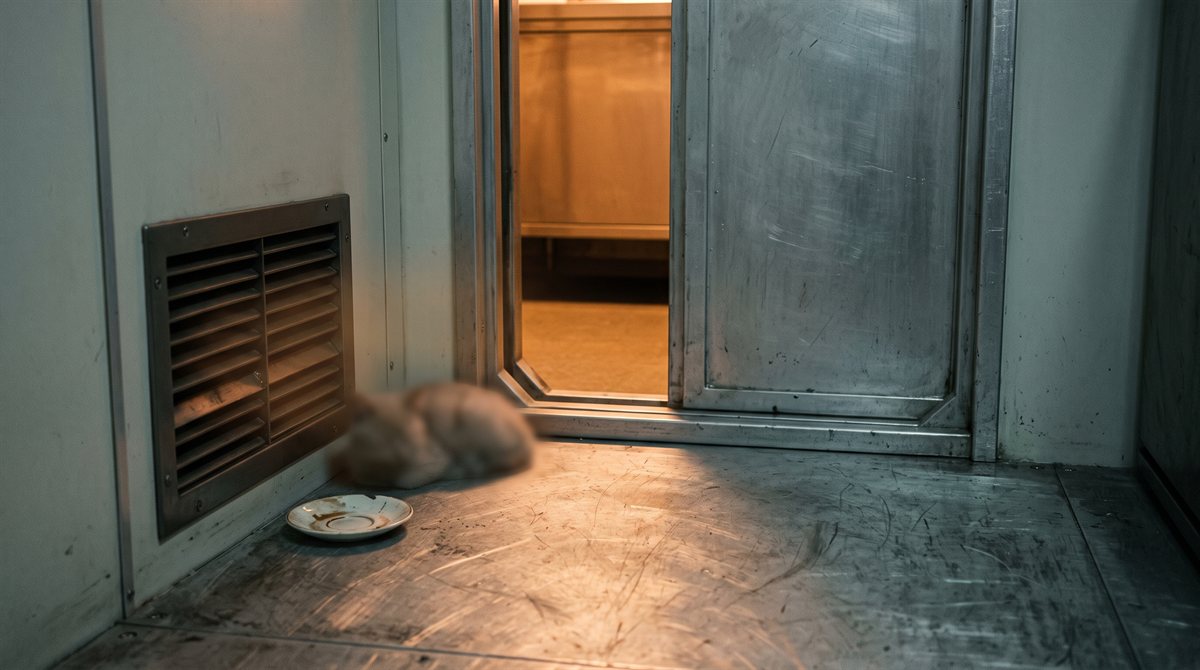
Muffin sits by the Deck 7 galley door where the warm air comes out. It is small. It is, by universal agreement, adorable. Beyond that the descriptions do not agree with one another and never have: eleven staff statements taken by Detective Inspector Albercombe's office over one shift returned a cat, a rabbit, a very young dog, and "you know — Muffin," and the four people who said cat did not agree about the colour. Nobody found this strange at the time. That is the first symptom, and it presents before any of the others.
The name is not the entity's. Eden's staff supplied it, the way people do, and it is doing more work than any of them realise. There is no procedure on this habitat by which a compliance-framework hazard report gets filed against something called Muffin, and everyone who has considered writing one has discovered this for themselves, privately, and put the form down.
What It Actually Does
Its feeding pattern is textbook and is the reason it was filed the way it was. Cute predators feed on micro-consent collapses: the small yes given because no would have been rude. Muffin does not take food. It is given food, all day, by people who did not mean to and would have said they were only being nice.
What accumulates is not the feeding. It is the habit. A deck that has spent nine months practising the small unearned yes gets better at it, and does not confine the skill to the galley door. Superintendent Oyelaran's bureau ran the numbers sideways, on a hunch that was not hers: over the same nine months, Deck 7's monitoring-officer sign-offs went from a median of two returned-for-correction per cycle to none at all, on a caseload that had not changed and a compliance framework that had grown by two more requirements. Nothing was falsified. Nothing was even wrong, so far as anyone could show. A deck's worth of people had simply, gradually, stopped being the kind of people who send a form back.
Nobody on Deck 7 was harmed. Everybody on Deck 7 got easier to ask.
The Filing, and What Is Wrong With It
Muffin was entered on Eden's hazard register as a lamb-mask: Class III, non-sapient, instinctive pattern-matching against vulnerability signals and nothing more. That filing was made from a description, by a duty officer, on the strength of the feeding pattern alone, and the feeding pattern does fit. Nine months of continuous observation do not.
Class III means no goals beyond the immediate feed, no learning, no preferences. What the log holds instead:
- It learns a door. When the galley's warm-air vent was rerouted during a refit, Muffin was at the new outlet inside two days, having tried three wrong ones first. Instinct does not try three wrong ones first.
- It has favourites. There is one cook it waits for, whose shift it anticipates by roughly a quarter hour, and from whom it has never once accepted anything.
- It gets bored. Yields on the galley approach fell off over the summer as the deck's newer staff rotated in already primed, and Muffin's attendance fell off with them — not to a better feeding ground, which would be pattern-matching, but to the laundry, where it did nothing for eleven days and then came back.
- It knows who is not going to work. See below.
None of that is strategy. It never once resolves into anything organised enough for the word to earn its keep, which is why nobody has proposed moving it to Class II either. It is simply an animal, and the sorting problem is the one Sí Gaoithe's crossers already put on record: a case the classification was not built to sort, rather than a gap in it.
Eden is, however, the first place the question could be calibrated, because Eden is the first place it came up with two certified benchmarks standing four metres away.
Why the Smart Pets
The lore is blunt about the detection: robots and cyber-enhanced animals of the detective agency find cute predators early, because their asymmetry detection is not distorted by social pressure to be polite. That part has held exactly as written.
What was not anticipated is that it would hold in both directions. Agent Barsik has never given Muffin anything, and Muffin stopped trying somewhere in the second month — not by avoiding him, which would be strategy, but the way any cat stops trying a door that has never once opened. Bubochka it worked considerably longer, and gave up on later, and her log records the exact week. Thrum it has never approached at all, which is the cleanest result in the file: a vessik has no apparatus for perceiving charm, so there is nothing to work with, nothing is attempted, and nothing is recorded.
Set against a cat and a rabbit whose cognition is certified, characterised and on file, the specimen benchmarks at roughly their order. Not below it. Barsik's own note on this is one line and he has not expanded it: it is about as clever as I am, and it is not certified as anything, and neither of those facts is the one that keeps me up.
The Difficulty
Everything the agency has is a negative. Its case is that four residents of one deck have never fed the entity, that one of the four is an animal with no social perception whatsoever, and that the sign-off numbers moved. None of that is a hazard finding, and none of it can be written on a form without the form containing the word Muffin.
The reclassification makes it worse rather than better. A non-sapient hazard is a thing you remove. An animal at the same order of cognition as a certified Smart Pet — carrying no subsystem, holding no certification, covered by no welfare framework Eden or the Compact has ever written — is a question nobody on this habitat wants to be the first to put in writing, and the Warden's Custos persona has not been asked. It is the same gap that leaves Barsik's and Bubochka's welfare formally outside the Warden's authority, and Thrum outside everything, arriving for a third time from the direction nobody had allowed for: the predator.
Barsik's position, filed once and not repeated, is that the counter has not changed. Somebody has to refuse it, out loud, in front of the others, and be the sort of person who can stand being rude for four seconds. He has noted that this is a great deal harder to arrange on Eden than a warrant, and that he would like it recorded that he knows what he is proposing to do it to.
Four Seconds
In late summer 2827 the specimen left the galley door for the walkway at shift change, and the deck stopped for it three days running; the housekeeping night pass took sixty-one unattended articles off the walkway on the third night, set down by people freeing a hand. The Inspector's office referred it to the bureau without naming it. What closed it was not the bureau. A boy, Lev Saunders, who had come to tell a rabbit that his cat was fine picked the specimen up from behind, under the front legs, told it no in front of the shift change, and shut it in a detective's rabbit carrier. It took four seconds. The file records the finding beside the act: the refusal counter works person by person, as it always has, and it costs nothing to a person who has not yet learned the small yes. See Four Seconds (S02E10C01).
It is kept, for now, by the boy's family, two decks down, on a small-livestock application that went into the compliance queue the same day. The register asks who keeps an animal and how it behaves, and does not ask what it is; the bracket where the species goes holds the one word every hazard form on the deck could not carry. Three readings were taken on the walkway and none was entered as a finding. The warm patch by the galley door has been empty since.
See also: On the Filing of the Galley Door Specimen, Predatory Entities, Meta-Dimensional Beings, Agent Barsik, Bubochka, Thrum.
Discussion
Show discussion
Comments are read after they are posted and anything unsuitable is removed. Posting needs a GitHub account; reading needs nothing.