Drithane
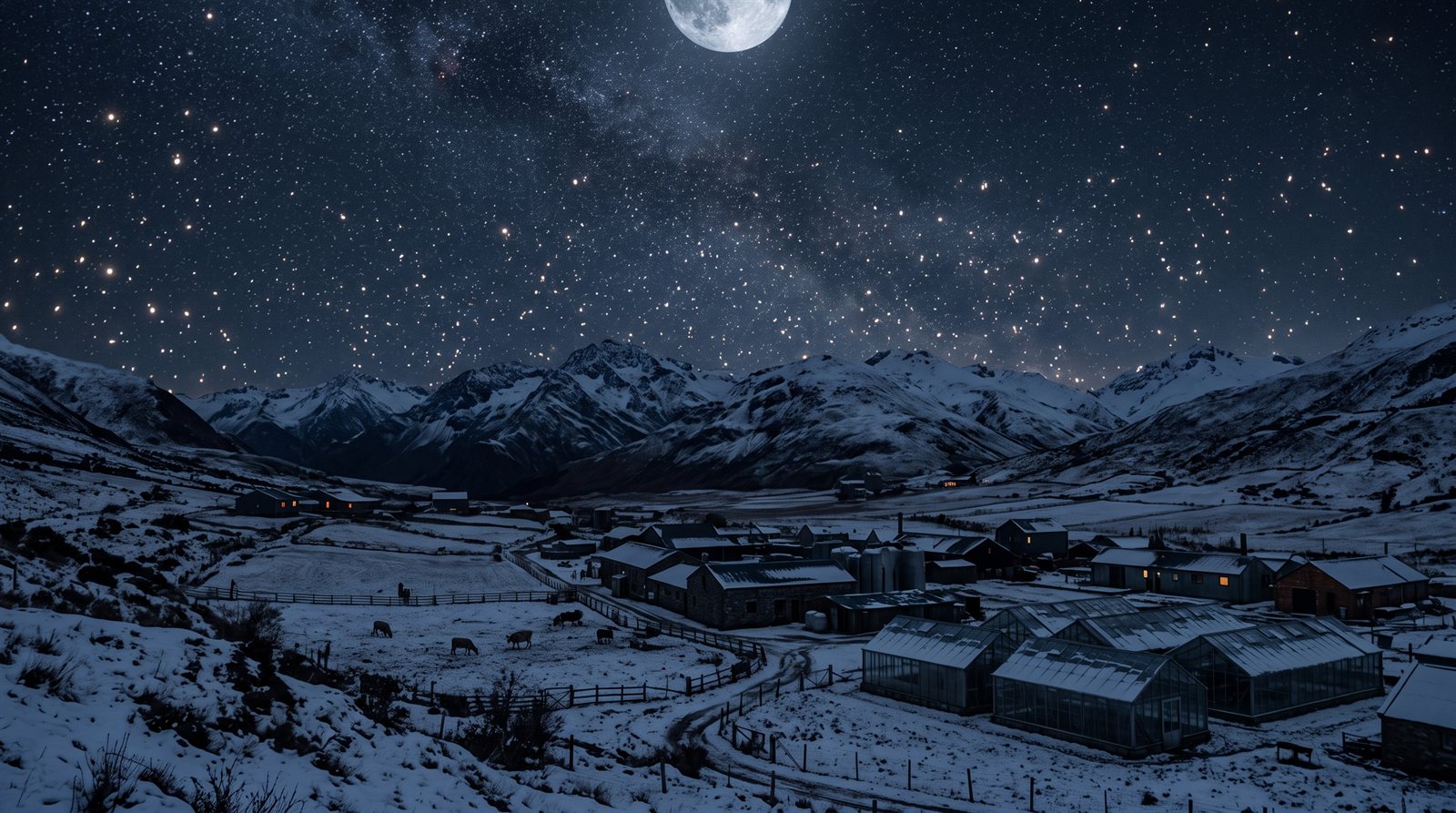
Drithane keeps polar ice at both caps and a winter snowline that walks well down into the settled valleys, and its nights are lit by a single low, bright moon over the snow — but nothing on Drithane makes the light it is named for. The sky does that twice an orbit, on a schedule its settlers learned to predict to the hour before they had finished unloading the ark.
Drithane — from the Irish drithle, a spark, a glimmer — is the fifth documented charter world of the Celtic Union of Planets, the second planet of the Bríd System, named by its founders for Brigid of the hearth and the forge. The founders were naming the system before they had chosen a world, and the world, as it turned out, named itself.
The Drithle
The Bríd System carries a broad, thin band of debris — the remains, on the Survey Corps' provisional reading, of a small moon of the system's outer gas giant disrupted long before settlement — inclined a few degrees to Drithane's orbital plane. Twice in every orbit the planet crosses it. The band's material is fine and slow relative to the planet, so almost all of it ablates high and gently: not the hard streaks of a fast meteor shower but slow, silent, white-gold sparks, bright enough on a clear crossing night to read by, persistent enough to watch one from horizon to horizon. Ground strikes of any consequence are unrecorded; the band has had a long time to grind itself fine.
The crossings are as predictable as anything in the system's mechanics, and settled life is arranged around them. Orbital traffic schedules to the calendar — the fine material that makes the display harmless on the ground is exactly what an unshielded hull prefers to avoid — and the Union's relay beacons above Drithane are armoured for it, an engineering line-item the other charter worlds do not carry.
A Cold World Under a Clear Sky
Drithane is cold, dry, and high — a thin but breathable-with-acclimatisation atmosphere, settlement concentrated in a connected chain of geothermal valley systems where water stays liquid and agriculture runs under glass. The land between the valleys is hardy grazing range worked in season, and the planet's export economy is correspondingly modest: wool, preserved goods, precision cold-climate botanicals, and — since reconnection — survey hospitality, because the same dry, high-altitude clarity that makes the drithle spectacular makes Drithane one of the best natural observation platforms in Union space.
Its founding cooperative was predominantly Irish-speaking, and Irish remains the world's working language under the Union's charter language policy. The settlement pattern never produced a capital: the valley chains govern themselves and send a rotating delegation to the Union council, an arrangement the founders copied deliberately from the confederation's own weak-centre design.
Crossing Nights
On crossing nights the settlements go dark by custom. Exterior lighting is shut down valley by valley as the crossing hour approaches — not by law, and no record of the custom ever needing one — and the world watches its own sky by the light the sky provides. Some households keep vigil observances on those nights, in traditions that predate reconnection and vary valley to valley; the Archive records the custom without ruling on its content, as it does elsewhere. Children on Drithane learn the crossing calendar the way children elsewhere learn tide tables.
Union Status and Contact
Drithane holds full Union charter membership and appears in the confederal record from ratification. To Solar System records it was, like Kernowek Reach, a name only for decades — listed in the Union's declared membership at reconnection, unvisited until a Survey Corps team following the boundary-zone information-sharing agreement made first documented contact and filed the system survey that named the debris band's likely origin. One charter world remains known to Solar System records by name only.
Under the 2723 Charter the Rangers hold no jurisdiction on Drithane and act there only by invitation, on the same terms as everywhere in Union space; the honour-escort protocol documented at Tír na nÓg applies on Drithane unchanged.
See also: The Celtic Union of Planets, Tír na nÓg, Kernowek Reach, Ynys Wydrin, Aethelrock.
Discussion
Show discussion
Comments are read after they are posted and anything unsuitable is removed. Posting needs a GitHub account; reading needs nothing.