The Umbral Moon
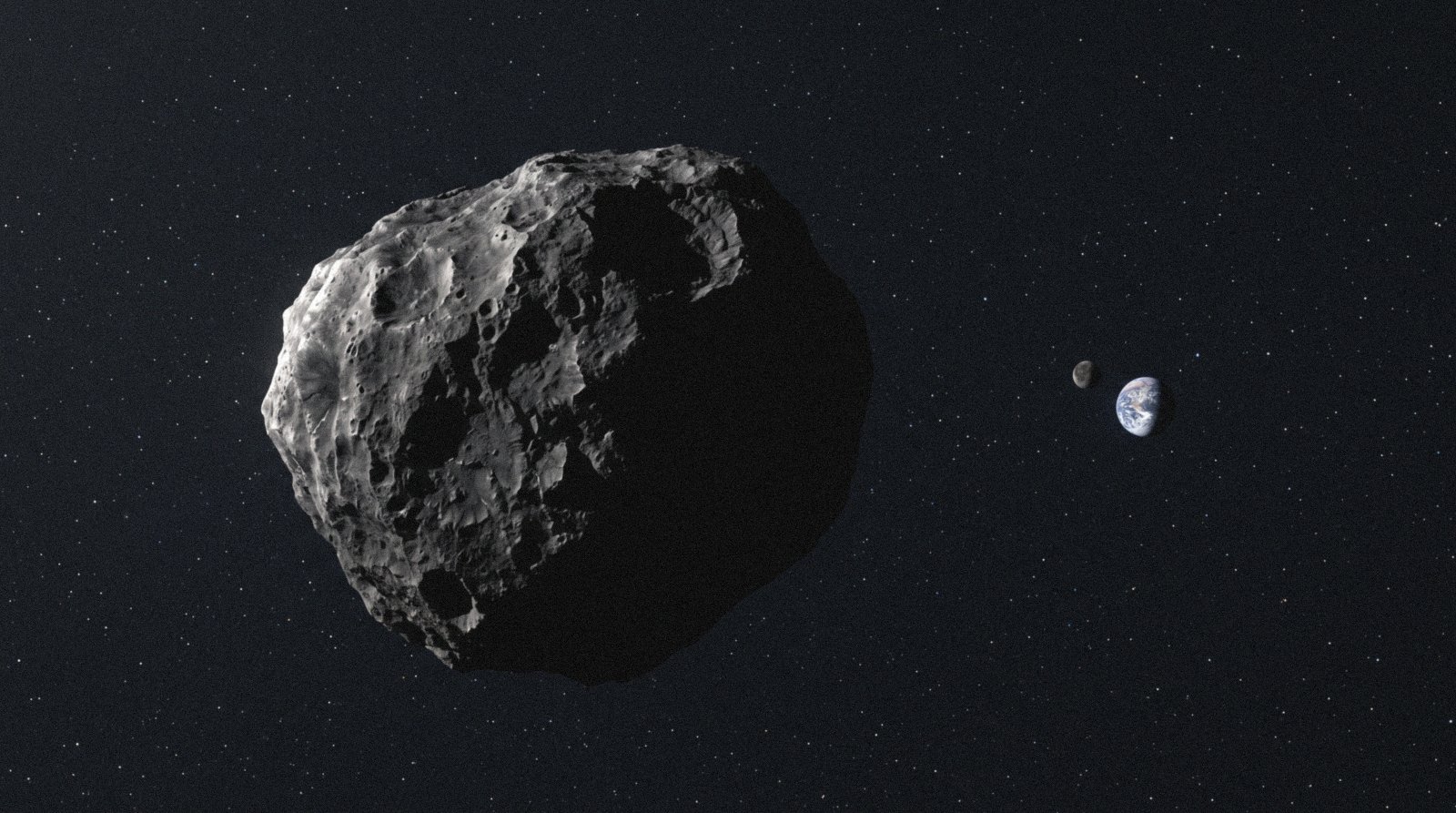
The Umbral Moon is the least remarkable object in the Solar System's most interesting parking space.
What Holds It, and What Does Not
Nothing exotic holds the Umbral Moon in place. It occupies the Earth–Moon L5 point, and it stays there for the reason anything stays at a Lagrange point: the arithmetic works. Bodies accumulate at L4 and L5 across the record and across the sky, and a small dark one accumulating at Earth's own is not a phenomenon. It is a Trojan.
This wants saying plainly, because the site's other property invites a much worse account. The moon is not suspended between universes, not held by a tunnel, and not resisting a pull from anywhere else. It is a body in the Material universe, entirely, sitting where the gradient is flat. A transient gravity tunnel — the only structure a narrowed Interval ever opens that anything crosses — forms and collapses on its own schedule, lasts seconds to minutes, and is "not stable enough to hold open on purpose." Nothing of that kind has ever held anything, least of all a moon, and the Survey Archive's file opens by saying so, because the first three proposals it received all said otherwise.
What It Shares the Point With
L5 also carries a flexure — a standing bend in this membrane's own geometry, drawing a patch of it toward a neighbour, so that the Interval narrows over that patch and nowhere else. It is the ordinary inter-membrane case: the same kind of edge Threshold Station and the Marsh Causeway sit on, and it behaves the same way.
Two things follow, and the record is careful about both.
The flexure is not what put the moon there, and the moon is not what put the flexure there. They share coordinates. A flexure is not made, not travelled, and not attracted to mass; an L5 point is a consequence of two bodies and their motion. That two unremarkable things coincide at one address is the kind of coincidence a boundary station is built on rather than an argument for design, and the file notes that the coincidence is doing no work in any account that needs it.
The membrane on the far side is not identified. This is standard rather than a gap: neither Threshold's neighbour nor the Causeway's is named either, because the Interval is manifold separation and carries no bearing, no distance, and nothing a survey could follow to see what is over there. The record has instruments for measuring that a neighbour is close. It has none for asking which one.
Why It Was Found Late
The moon is small, dark, and in a place nobody photographs — L5 holds dust, and dust is what a survey expects to find there. What eventually found it was not an image.
Eden's research intelligences flagged anomalous gravitational micro-pulses in a data set collected for something else. The pulses are the flexure rather than the moon: as the Interval over the patch narrows and widens, a coherent mass on the far side registers intermittently on this side as gravitational field structure with nothing behind it — a signature with no thermal or mass return, legible only to a cross-membrane gravimeter and to a pattern-finder patient enough to notice it recurring. The moon turned up in the follow-up survey, sitting in the middle of the anomaly and having nothing to do with it.
New London, stationed at the same point, had been logging Etheric disturbances from the flexure's edges for considerably longer, and filing them under station maintenance. The Survey Archive's annotation on this is the one it makes about every such case and has stopped enjoying making: the readings were correct throughout, and nobody had asked the question they were answers to.
Crossings
Class III incursives have been recorded at the site, and the site's reputation rests almost entirely on it. They are non-sapient, meta-dimensional, and sub-Levril in causal authority — not intelligent and not inert, capable of displacing local physics by being present. A boundary event is the ordinary circumstance in which they are introduced, and a Class III excursion at a narrowing is a boundary event.
They are not the natives of anywhere on the far side, and the record declines the account that makes them so. A meta-dimensional being extends across higher spatial dimensions rather than living in a universe next door, so "which realm do they come from" is a question with the wrong shape, asked of entities that do not have a from. What the flexure supplies is not a door to their country. It is a place where the local physics is thin enough that their presence registers.
Crossings here are more frequent than at any other documented site inside the Solar System, which is a statement about the Solar System's instruments as much as about the site. The Archive's standing annotation from the boundary-zone record applies unchanged: the sites on the books are not the sites that exist, they are the sites that could be stood on — and this one is within a habitat's watch, a short transit from Eden, and closer to the Kingdom of the Five Islands than any other narrowing on file.
See Also
- Boundary Zones and Concordant Edges — the flexure, and the Boundary Types
- Concordant Membranes — the Interval, and what a transient gravity tunnel actually is
- Membrane Shadows — far-side mass registering with nothing behind it
- Meta-Dimensional Beings: Classification — where Class III incursives sit, and do not
- New London Space Habitat — stationed at the same point, and filing it under maintenance
Discussion
Show discussion
Comments are read after they are posted and anything unsuitable is removed. Posting needs a GitHub account; reading needs nothing.