Membrane Shadows: Gravitational Imprints from Adjacent Membranes
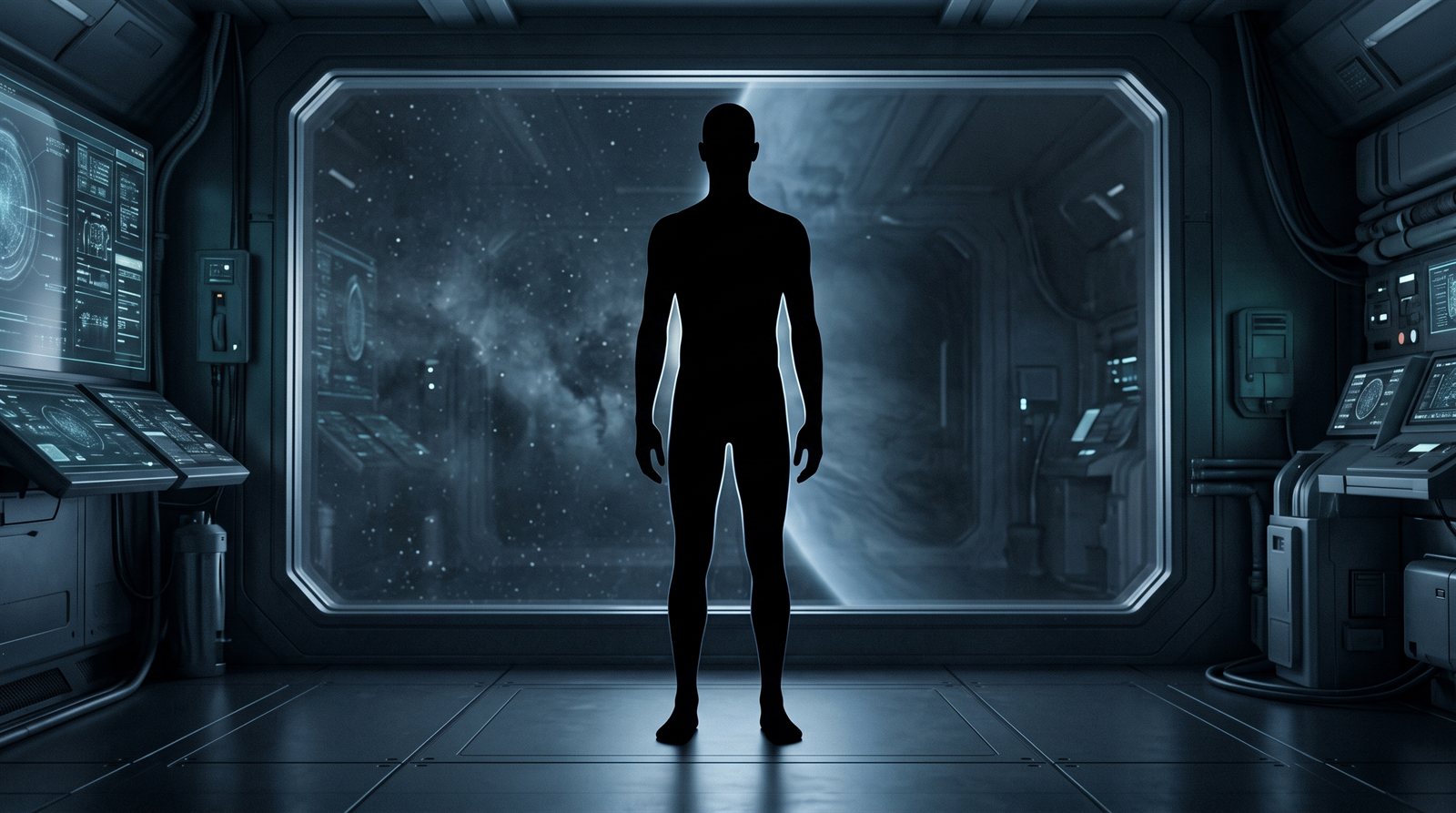
A figure can stand between a boundary-zone observer and the light, throw a full, edge-lit silhouette, and never once have crossed into that observer's universe to do it. Survey Corps calls the shape a Membrane Shadow. Nothing about the name is a metaphor.
The Phenomenon
A Membrane Shadow is the locally observable gravitational imprint cast by a coherent mass on the far side of a narrowed Interval — which is to say, in a neighbouring universe. Membranes are universes, so this effect has no intra-universe form: two Concordant Zones of the same universe share an ordinary internal edge with no Interval across it, and cast no shadows into each other. It is not a creature, not a visitor, and not something that has crossed the boundary at all. The mass responsible for it — most often a living being, moving under its own will — can remain entirely within its own universe, on its own membrane, for the imprint's whole duration. What reaches this side of the gap is not the being. It is the being's gravity.
Mechanism: The Physical Channel of Intermembrane Bleed
Concordant Membranes and Intermembrane Bleed already documents two observables of one membrane-proximity event, read through different bands of the post-11 manifold: an Etheric signature (Membrane Resonance, escalating to Intermembrane Bleed) and a Physical signature, tabulated there only in general terms — "rapid discontinuity growth" at a Type III Shear Event.
A Membrane Shadow is what that Physical-channel signature looks like when it is not general. Dimensions 12–15 distribute geometric strain when membranes overlap; at Type III separation, that strain-distribution is a real, bounded, non-tearing coupling between the two membranes' gravitational fields, sufficient to register the far side's mass distribution as a local anomaly. Under Type I or II separation this reads as noise, indistinguishable from ordinary local-constant drift. At Type III proximity, if the far-side mass is concentrated and coherent enough — body-shaped, moving with what reads as intent because the source across the gap is moving with intent — the strain takes that shape, and a body-shaped region of strained geometry bends and dims ambient light much as a solid object would, with no solid object present on this side of the boundary at all.
The neighbour supplies the shape; the Interval supplies the strength. This is the point the entry's earliest readers most often got backwards, and it matters because the arithmetic will not survive the other reading. A body's own gravity, leaking across a gap and acting on light a metre away, would deflect it by an amount no instrument ever built could register: the weight of a person does not bend light, on this side of an Interval or any other. What bends it is the strain between two membranes brought to Type III proximity — geometric distortion whose energy is the proximity's, not the body's — and what the far-side mass does is pattern that strain. The coupling in dimensions 12–15 distributes strain according to where mass sits on either side, so a coherent mass close to the gap imposes its own outline on a distortion that would otherwise be diffuse. The outline is the neighbour's. The magnitude is the boundary's. That is why a Membrane Shadow exists only at Type III, why it can load a bulkhead no person's weight could, and why its strength is telemetry about the Interval rather than about whoever is standing on the far side of it.
Why They Look Like Something
The signature is consistent wherever it is documented: a dense-edged silhouette, rim-lit where passing light bends around it rather than through it, casting no shadow of its own — because it is the shadow phenomenon, not a body that could cast a second one. It registers on nothing configured to detect mass, heat, or motion on this side of the boundary; only a cross-membrane gravimeter shows anything at all. It is silent, because there is no matter present on this side to displace air or strike a surface.
The Bright Case: Photographic Beings
The strain that makes a Shadow is a lens, and a lens does two things. Where its geometry diverges, the light it bends leaves the observer's line and a silhouette stands where the light was; where its geometry converges, the light it bends is brought together, and the far side's outline stands in the air as a figure made of gathered daylight. The record calls the second a Photographic Being — the Kingdom of the Five Islands' word, rendered by its delegation — and the Survey Corps files it as a membrane caustic. It is not a second phenomenon. It is the same Type III strain-coupling in dimensions 12–15, the same rule that the neighbour supplies the shape and the Interval the strength, and the same absolute that nothing crosses: the light is this side's, gathered over a body's outline and never to a point, so the figure is bright enough to read as a person at noon, fades with the day, cannot be seen in the dark, casts nothing and burns nothing. A hand through it dims it where the hand is. It moves as the neighbour moves. Where one far-side mass patterns both geometries, the image is ringed by its own dimming.
Two consequences follow for the field. Converging geometry is the narrower condition, so caustics are rarer than Shadows and the record's estimate — one image to some tens of Shadows — is expected to move as more boundary zones are watched by day, since a Shadow is easiest to see against light and a caustic is invisible without it. And the diagnostic is unchanged: an optical signature with no thermal or mass signature is a boundary phenomenon whichever way the light went, and only a cross-membrane gravimeter registers it directly. The open question below is open for the bright case too.
The Benevolent Case: The Caomhari and the Dryads
Not every Membrane Shadow is dark. The name is an artefact of which cases got documented first — boundary-zone incident reports, where a dense rim-lit silhouette is what a nervous watch officer files at three in the morning — and it has misled readers of this entry ever since. Shadow here names the mechanism, not the appearance: an imprint cast by a mass on the far side of a narrowed Interval. What that imprint looks like depends on what is casting it, and the record holds pale ones, luminous ones, ones that read as a brightening rather than a darkening, and ones with no tonal character at all — a place that is simply occupied without being lit or unlit. The dark silhouette is the commonest published form and the least representative of the range.
Nor is a Membrane Shadow reliably person-shaped. The same documentary bias is at work: a watch officer files the ones that looked like somebody standing there, and files them urgently, while a shape with no name goes into a log as an instrument fault. But the imprint follows the mass casting it, and there is no reason for a coherent mass in a neighbouring universe to be shaped like a person — the record's own position is that almost nothing anywhere is. So the register runs much wider than the reports suggest: forms with no orientation, no front and no top; long ones, branching ones, ones that read as an interruption in a surface rather than an object on it; and the humanoid cases, which are the minority that gets written down because they are the ones a witness has a word for.
The two exceptions to that scarcity are the ones this page's next section covers, and they are exceptions for a stated reason rather than by accident. The Caomhari — the Union's Good People — and the Dryads are Membrane Shadows too — the same mechanism, the same absence of a body on this side, and a wholly different disposition on the other. This is one of three ways the Caomhari are met, and the only one with neither a body nor light: where the lens converges, the same outline can stand as a Photographic Being, an image of this side's daylight with nothing crossed; and at a Conjunction window a transient gravity tunnel lets them cross in a body, luminous by their own voice (Luminescent Ethereal Beings). The record cannot say whether any witness has met the same person more than one way. What differs is not the physics but the neighbour: where the far-side mass casting the imprint is a being of the Harmonic Membrane, what arrives is not a dense figure at the edge of vision but a presentation shaped to be met, and met kindly.
Three things follow, and each resolves something the record had been carrying separately.
The distribution stops being a coincidence. The Caomhari and the Dryads are reported only where the Harmonic Membrane runs close enough — such as parts of Tír na nÓg — which is exactly what this page already says about shadows generally: the Interval has to be narrow. Two folkloric categories and one instrument reading were describing the same condition from three directions.
The old accounts were never confused. A tradition that files fairies, tree-people and the dark thing at the field's edge in one category of not-quite-there had noticed a real kinship centuries before anyone measured an Interval. The vocabulary was pre-scientific. The taxonomy was correct.
Benevolence is not a property of the mechanism. Nothing about intermembrane bleed is disposed one way or the other; it is a channel, and what comes through it depends on what is standing on the far side. So the pleasant cases and the unpleasant ones are not two phenomena to be told apart by their behaviour — they are one phenomenon whose character is set entirely by a neighbour nobody on this side has met. That is a more unsettling thought than a haunting, and the record does not soften it.
Not a Meta-Dimensional Being
Membrane Shadows are routinely misfiled alongside the non-sapient incursives in Meta-Dimensional Beings: Classification's Class III, because both present as dark, roughly person- or creature-shaped anomalies at boundary zones. Until 2026 the misfiling had a second cause, since removed: the Class III beings were called shadow beings, so the two categories shared a word as well as a silhouette. They are now incursives, which names the thing that actually separates them. They are not the same phenomenon, and the distinction is operationally load-bearing, not academic:
- A Class III incursive has entered material space. It is physically present, can be touched — dangerously — and displaces local physics through its own extension into this Concordant.
- A Membrane Shadow has entered nothing. No mass has crossed the gap. Every gram responsible for the imprint stays on the far side, in its own, fully separate universe. What crosses is field structure, not the being generating it.
This puts Membrane Shadows outside the Cosmic Cascade's standing hierarchy by category, not merely by class: the Cascade governs beings, and a Membrane Shadow is not a being. It is a symptom of one, read through a gap.
Not an Alternate-Timeline Double
A Membrane Shadow that resolves into a familiar outline — a silhouette that reads, uncannily, as someone the observer knows — is not that person's counterpart from a branching version of the same history. Nothing in the Grand Ensemble works that way: primary universes are independently authored by separate Worldwrights, not variants of one timeline splitting into alternatives, so there is no shared origin for a far-side being to have diverged from in the first place. A resemblance is either coincidence — convergent Worldwright design landing on a similar form, the way unrelated Concordants can independently produce similar physics — or, more mundanely, a human observer's pattern-matching doing to an ambiguous silhouette what it does to clouds and static. Survey Corps treats "it looked like someone I know" as an observation about the witness's own pattern-matching first, and a claim about the far side a distant second.
Hazards
Nothing crosses, but a Membrane Shadow is not inert:
- The gravitational gradient near a strong one is real, not perceptual — the same strain-distribution mechanism fold scaffolding already treats as a stability variable can put measurable structural load on installations near an active boundary station. The load is set by the coupling, not by the far-side body's weight, which is why an imprint the size of a person can stress a structure no person could.
- A moving Membrane Shadow means something coherent is moving on the far side with enough mass and consistency to register. That is live telemetry about membrane proximity escalating toward Type III, not decoration, and boundary-station protocol treats it as such.
- Personnel at Threshold-class stations are trained neither to treat a Membrane Shadow as an immediate combat threat — it cannot act on this side of the boundary, at all, under any circumstance — nor to dismiss it, since ignoring one has historically meant ignoring the Shear Event it was warning about.
An Open Question
Nothing rules out the possibility that a shape coherent enough to read as a being is coincidental mass distribution rather than deliberate. Nothing confirms it either. Survey Corps has no documented case of two-way signalling through a Membrane Shadow — a far-side being shaping its own mass on purpose, to be seen, rather than simply being seen. It also has no documented case ruling that out. Until an instrumented log settles it one way or the other, both readings stay open.
Detection
- Cross-membrane gravimeters, not the optical/thermal detection loop used for Class II/III meta-dimensional beings, are the only instruments that register a Membrane Shadow directly, as a gravitational anomaly.
- A Membrane Shadow can be photographed — the light bending around it is real and physical — but returns nothing on infrared or motion-mass sensors, which is itself diagnostic: a shape with an optical signature and no thermal or mass signature is a Membrane Shadow, not a Class III incursive, almost by definition.
- A Photographic Being photographs as what it is, a figure of ambient light: every photometer that has looked returns the sky's spectrum, and a figure that fades with the day and returns nothing on infrared is the bright case of the same phenomenon, not a source.
See also: Concordant Membranes and Intermembrane Bleed, Boundary Zones and Concordant Edges, The Common Manifold, Meta-Dimensional Beings: Classification, The Grand Ensemble Multiverse.
Discussion
Show discussion
Comments are read after they are posted and anything unsuitable is removed. Posting needs a GitHub account; reading needs nothing.