Hester Aldous
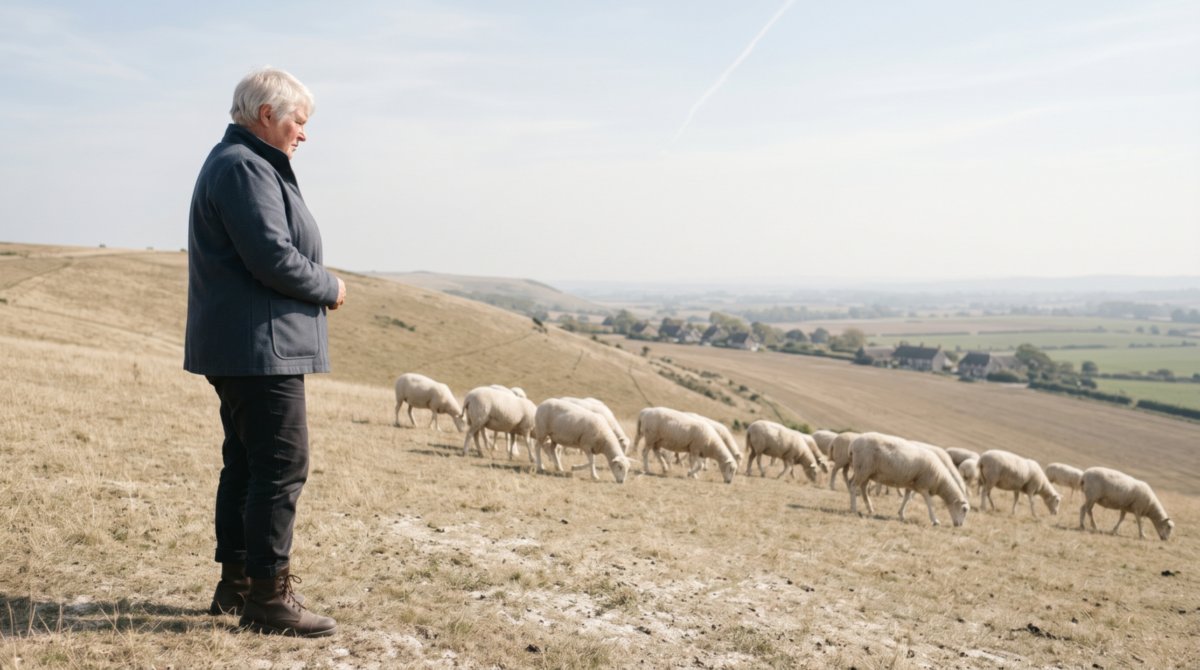
Hester Aldous keeps the flock. On Winterbourne the downland turf is not a natural state but a product of the sheep: left ungrazed it goes to scrub within a decade and to woodland inside a century, which has happened twice on record where a parish lost its flock, and been reversed both times by putting the flock back. Keeping the flock on the ground is her trade, and so, without anyone saying so, is keeping the ground. She is the first person of Winterbourne the record names, and the Archive calls her the first of nothing else: a parish's flock is somebody's work, as its ledgers or its shielding are elsewhere in the record.
She was born in Marlbrook, one of the villages on the spring line, in about 2769 UCSD, to a family the record does not count back. The village is older than any family in it and sits where it sits because that is where the water comes out: rain falling on the high down percolates through four hundred metres of chalk to the clay beneath, runs sideways, and emerges at the foot of the scarp in a line of springs two to three kilometres apart, and every one of those springs has a village on it. Marlbrook's parish runs, as every parish on the world does, in a long narrow strip perpendicular to the line of villages, from the wet meadow at the bottom, up across the arable of the lower slope, to the open grazing on the high down. The top band is hers.
The name is given as the record holds it. Winterbourne's founders were none of the Celtic Union's six charter traditions, and the names on the world's own page, Ashenden, Chilverstoke, Downminster, set a register of their own, old and of the downs; what hers owes to that register, or to the generations since landfall, the record does not say and has not asked. The record renders her as she.
Known History
- Born in Marlbrook, on Winterbourne in the Albion system, in about 2769 UCSD. The year is the record's reading from her working age in 2826, and not a date the parish register has been asked for.
- Shepherd of the Marlbrook parish flock in the record's present, 2826 UCSD. How long the flock has been hers, and from whom she had it, the record does not say.
- Never off Winterbourne in any account the record holds. The fold route to the nearest transit point is a day's run, and nothing on her page has needed it.
- Not a member of the Marlbrook parish council in any account the record holds, and not a party to any of the occasions on which Union membership has been raised informally and undertaken to be considered at the next meeting.
The Work
The planet's page gives the trade in one clause: a settlement wants water, ground it can plough, and somewhere to run sheep, and on Winterbourne the three things lie in bands one above the other. The sheep are the top band, and the top band is the one that does not keep itself. The wet meadow stays meadow because it is wet, the arable stays arable because somebody ploughs it, and the open down stays open only while a flock is on it. Twice in the parish records a stretch of downland lost its flock and went to scrub within a decade and toward woodland inside a century, until the sheep came back; The Forest Is Waiting files it as the record's small, canonical case of what land does when everyone else stops. Aldous's share of the labour is to see that, on the Marlbrook strip, nobody stops.
Everything in her care came off the ship. The world supplied air, water and chalk, and that is the whole of it: the Survey Corps' ecology branch logs the native biosphere as marine and the downs, before the founders, as bare rock under a crust of nothing taller than a lichen. The turf is Terran, the arable is Terran, the reed in the thatch is Terran, and the sheep that keep the turf are Terran stock, set into the chalk's weathered mantle with the soil life they needed over the first generations, which is the labour the world asked of its founders in place of a dome. The Thin Inheritance calls the parish strips a polity drawn on a soil profile. The soil is a few centuries old, and it is held where it is by roots, and the roots are held short by the flock. Nothing native is eaten, and nothing native was cleared to make room. The sheep are not in Tír na nÓg's category, and neither is anything else on the down.
The streams she grew up beside are winterbournes: they run from midwinter to early summer while the water table stands high, then fall back to dry gravel by late summer and stay that way until the rain returns. Nobody on the planet finds this remarkable, which is why the world is named for it. The high down has no stream at any season, and where the flock drinks in the dry half of the year, the record does not say; the one water on the high down the record describes is Winnow Hanger's dew pond, four kilometres from any spring and fed by mist combed out of a hillside wood, and that is Winnow Hanger's, not Marlbrook's. What the flock does on the arable, if it comes down to it at all, the record does not say either.
None of this is quaint in the sense of being backward. The thatch on the Marlbrook houses is certified and periodically recertified, the medicine is current, and the fold route is a day away. What the Record Refuses says of places like hers that technology which does not announce itself does not reshape what a place looks like, and nothing about the last several centuries has made a sheep stop keeping a hillside.
Character Notes
The record holds her manner from her trade and from nothing else, since no chapter has met her, and the trade is exact in a way that is easy to mistake for a slow one. A flock is counted, not estimated. A stretch of turf going to scrub is seen in its first season or it is seen in its tenth, and the two are not the same amount of work. She does not move the flock because the lane is easier that way; she moves it because the ground under it has had enough. When a parish loses its flock, the record says what follows and in what order, and the record has no account of her saying it to anyone, because on Marlbrook's strip it has not needed saying.
She lives under the world's one unsettled question and above it. Three accounts are held of whether the pattern she lives inside was intended: that a founding instrument prescribed the parish layout, the village spacing and the strip boundaries; that no document was needed, because the same rock, the same water and the same animal produce the same answer anywhere they occur together; and that the instrument on file is a fair copy of uncertain date in a hand that is not the one it claims. None has been adjudicated, and the Archive has not been asked to try. The record does not hold which of the three she takes to be true, and has no reason to think she has been asked. What the file does note is the one observation none of the three has to explain away, that wherever the spring line runs the villages are on it, on a world where nobody had to be told; and the sheep were told nothing either, and the turf is wherever they are.
She has never been asked to consider Union membership at the next meeting, and the record places her at no meeting. Winterbourne holds no Solar System charter and no Union membership, which puts it in the same administrative category as the Kingdom of the Five Islands for entirely different reasons, and the question has never been pressed. Nothing on her page presses it.
The record gives her no kin by name, no day, and no account of her own in her own words. It places her on the open down at the top of the Marlbrook strip, on Winterbourne in the late summer of 2826 UCSD, with the flock below her on pale dry turf and the stream in the valley dry gravel, and nowhere else.
What the Record Does Not Carry
Her kin. What the name owes to the register of the world's place-names, or to the generations since landfall, and where the founders came from, since the page says only whose traditions they were not. The size and breed of the Marlbrook flock, where it drinks in the dry half of the year, what it does on the arable, and where its wool and meat go, whether to Downminster's market or further. Whether Marlbrook is either of the two parishes on record that lost a flock, and whether she has seen a down go to scrub with her own eyes or knows it from the parish record. How a parish flock is held, by the parish, by a family or by her, and how a shepherd comes to it. Whether a dog works the flock with her, since the page names the sheep as Terran stock and names no other animal. Whether she sits on the parish council, has ever been to one of its meetings, or holds any view of the Union question on record. Which of the three accounts of the founding she holds, and whether anyone has asked her. Whether she has met a Ranger, a liaison or a recruiter, since the planet's page links the office and names no visit. Whether she has been to Winnow Hanger, or off the Marlbrook strip at all. Any chapter. The body, beyond what a working life out of doors on an open chalk down gives anyone: the record states nothing of it, and the portrait, when it is made, will be the picture's reading and not the page's.
See also
- Winterbourne, the world, its spring line, its villages and the question it will not settle
- The Forest Is Waiting and The Thin Inheritance, for why the turf needs the flock and the soil needs the turf
- Rivers Old, Lakes Young, for the water under the down and where it comes out
- What the Record Refuses, for why a certified thatch and a day's fold route leave a village looking like a village
- New Cotswolds, the record's other downland country, where the intent is a filed document with a date on it
- The Kingdom of the Five Islands and The Celtic Union of Planets, for the administrative category Winterbourne shares with the one and the membership it has never pressed with the other
Discussion
Show discussion
Comments are read after they are posted and anything unsuitable is removed. Posting needs a GitHub account; reading needs nothing.