The Ledger and the Truce
Among the driest surfaces in the settled record is one of its coldest. Fliade's open ground is thin, dry, and mineral-sharp, swept by wind that smells of ice and deep stone — and it is a desert by the only definition the survey uses, which mentions no temperature at all. A desert is a line in a ledger: more water leaving the ground than arriving on it. Heat is one way to run that deficit. It is not the only way, and it is not even the most thorough.
A Desert Is a Signature
Every desert was made by something, and the record can usually read the signature — each kind is one of the other planetary doctrines run to its edge.
A range wrings the moisture out of crossing wind and casts a dry shadow behind it, so a rain-shadow desert is the mountain doctrine's receipt. Distance does the same by attrition — a continental interior is dry because no weather system carries water that far inland intact. Cold runs the deficit from the other side of the ledger: Fliade's surface has water, locked as permafrost where the biosphere cannot spend it, which is the freshwater doctrine's missing surface chapter restated as aridity — the driest deserts anywhere are the cold ones, because frozen water pays no bills. And Aspenar shows the mineral extreme, a barren surface too bright and too metal-rich to walk unshielded: ground that skipped the argument about water entirely.
What a desert is not, on any surveyed world, is empty. It is precise — a place where the margins are thin enough that everything living there is an exact answer to a stated problem. The Serephine Dunekin of Kharis Belt IV are the worked case at civilisation scale: a people who open twice a day, living on the gradient between a furnace afternoon and a frozen night, who smelt with focused sunlight because their thin air will not carry a flame — a whole civilisation run on the one resource a desert has in surplus, which is contrast. Thin, dry air keeps no heat overnight; the desert's great diurnal swing is not a hardship the Dunekin endure but the engine they built everything on.
And deserts collect contemplatives, on more worlds than one. The Monasteries of Mars are built into open, thin-atmosphere terrain by deliberate preference — the oldest monastic instinct in the human record, that the desert is where you go when you mean it, carried to a desert no Earth hermit ever had.
A Grassland Is a Truce
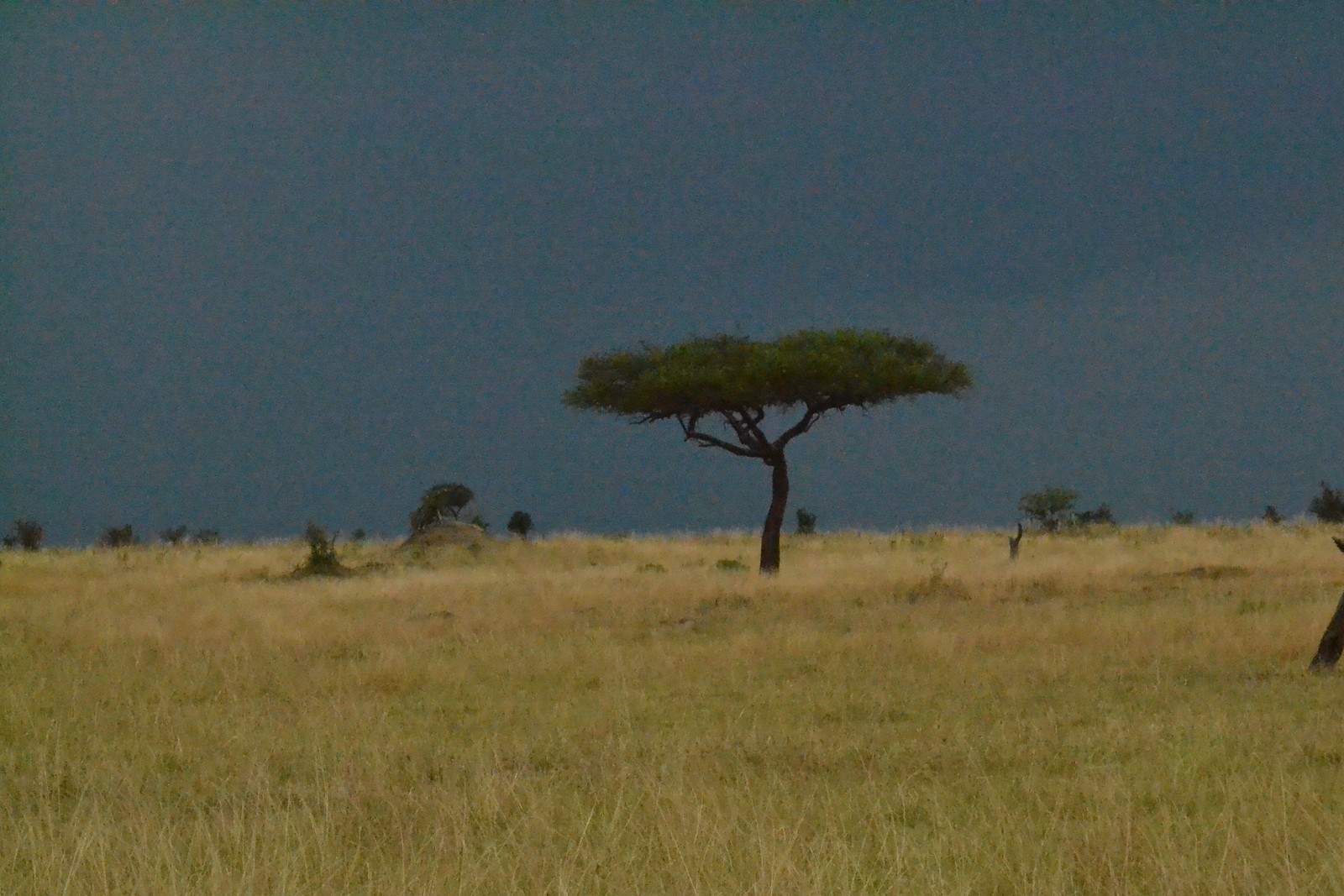
Grass is a strategy, not a place. Trígrian's page states the record's whole position in one line: the land is grass because grass is what survives — deep-rooted, fast-seeding, indifferent to losing everything above the soil, the growth-form you evolve when the climate cannot be trusted from one year to the next.
Which means a grassland is not a fixed biome but a truce between the desert on one side and the forest on the other, and the truce holds only while something enforces it. The record knows three enforcers. Fire, on Trígrian, where the triple sunset opens a burning season that kills the standing cover across a continent and the ash feeds soils of exceptional depth — the violence and the fertility being one cycle, not a cycle and its cost. Teeth, on Winterbourne, whose downland turf is a product of the sheep and not a natural state: left ungrazed it goes to scrub within a decade and woodland inside a century, which has happened twice on record and been reversed both times by putting the flock back. Climate itself, on Verdance's steppe, where seasonal grass and water cycles do the enforcing and the native herding ecologies answer with the grassland's characteristic politics — movement structured around the cycles rather than fixed territory, because on grass, staying put is the one strategy the land does not reward.
Remove the enforcer and the truce walks, in whichever direction the water ledger points. That is the deep kinship between this entry's two subjects: the desert edge and the forest edge of a grassland are the same boundary read from opposite sides, and both move. On most worlds they move on soil clocks, too slowly to watch. On Trígrian they move within a lifetime, and the herds move with them.
The survey habit that follows closes the set where it began: biomes, like mountains, are rates wearing the costume of places. A desert is a deficit still running; a grassland is a truce still enforced; and a map of either is dated the day it is drawn.
See also: Weather on Other Worlds, Rivers Old, Lakes Young, Stone, Fire, and Ice, Trígrian, The Serephine Dunekin, Verdance, The Monasteries of Mars.
Discussion
Show discussion
Comments are read after they are posted and anything unsuitable is removed. Posting needs a GitHub account; reading needs nothing.