Who Governs a Universe
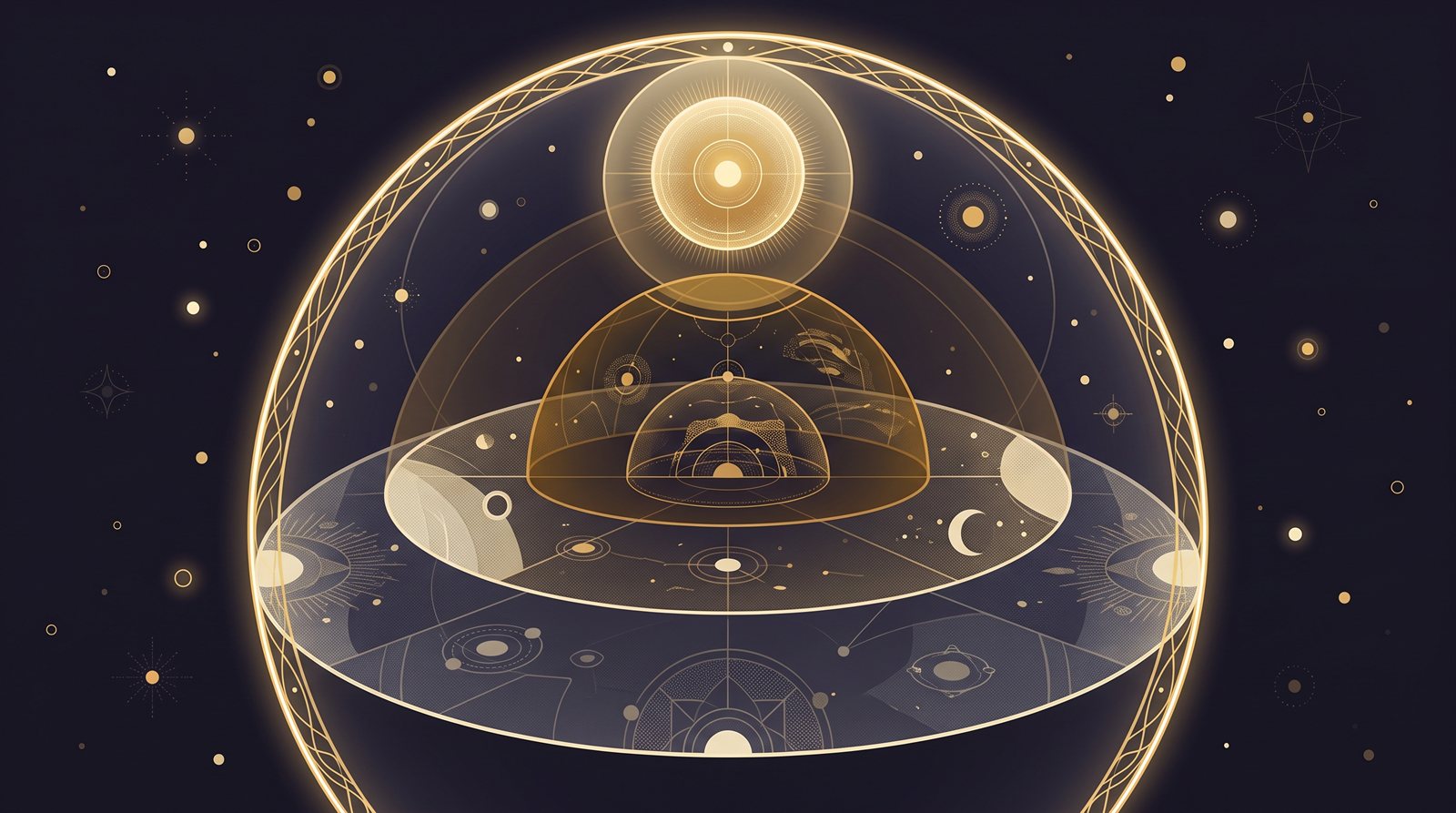
Asked once to explain the Cascade, Asteria the Sage sighed and said, "Where do I even begin?" The Archive's answer, after long practice with the same question, is: begin with two distinctions, because nearly every confusion about the Cascade turns out to be one of them wearing a costume.
Who governs a universe depends on what you mean by universe, and on which of three very different kinds of authority you are actually asking about. This entry fixes both distinctions in one place. The Cosmic Cascade entry gives the full tier-by-tier hierarchy; the Canonical Glossary gives the terminology law. This entry gives the map.
The First Distinction: A Universe Is Not a Zone
A primary universe is created by a Worldwright — the whole vessel at once: its physics envelope, its Etheric coupling, its interaction regime with neighbouring universes, and its internal zone structure. Only primary universes possess Worldwrights. Secondary and tertiary universes emerge through overlap and intersection between primary ones, and no new Worldwright attends them.
A Concordant Zone — Concordant for short, Concordance in the plural — is a bounded region within a universe where one internally consistent physical and Etheric rule-set holds. A universe contains many. Adjacent zones can differ, and where they meet, boundary zones form with all their measurable strangeness: instrument disagreement without device failure, timebase mismatch across short spatial baselines.
The containment order is the whole point. The universe is the unit of creation; the zone is the unit of consistency. When older records say a Worldwright "establishes a Concordant," read them carefully: Worldwright authority does extend down to zone structure, but a zone exists only inside a universe that a Worldwright made, and no Worldwright carves zones freestanding. You cannot have a Concordant Zone of nothing.
The Second Distinction: Three Kinds of Authority
Ask who is in charge out there and you will get three different answers, all correct, about three different offices. Confusing them is the second-commonest error in Cascade literacy, and unlike the first it is not harmless, because the three have different scopes, different origins, and different things they are forbidden to do.
Concordant Principals
A Concordant Principal — commonly, a Harmonarch — is the governing mind of a single Concordant Zone. Principals administer the zone's rule-set — they keep its physics and Etheric conditions coherent day to day — but they do not author it. The rules are the Worldwright's design; the Principal is the steward, not the legislator. A Principal's writ ends at its zone's boundary, which is precisely why boundary zones are nobody's tidy jurisdiction and everybody's problem.
Universal Authorities
A Universal Authority is the native governance body of a universe as a whole — its Concordant Principals in council, plus a presiding seat. Authorities maintain universe-level balance — CEI regulation, entropy behavior, continuity constraints, the systemic health of the whole vessel.
Here the second distinction nearly collapses back into the first, and it is worth slowing down. A Universal Authority is not a fourth being standing above the Principals. It is the Principals, in council, plus one presiding seat.
- The Council of Harmonarchs — every Concordant Principal in the universe, sitting together.
- The founder in that presiding seat, where the universe has one: its originating seed mind, in a universe raised by noögenic seeding.
- A lead Harmonarch in that seat instead, drawn from the Council, where the universe has no founder.
That composition answers the question the previous paragraph raises. If the Principals answer to the Authority, and the Authority is the Principals, what exactly is being obeyed? A council — which is an ordinary enough thing to obey. The Council's remit is universe-wide where any single Harmonarch's ends at a zone boundary, and a Harmonarch outvoted in council is bound by the decision inside its own zone regardless. The body holds powers no member holds alone. That is the whole point of constituting one.
It also disposes of an apparent oddity in the record: Authorities described sometimes as single minds and sometimes as plural ones, with Synarch Minds and Consensus Fields documented in the Canonical Glossary. Both descriptions are of the same institution. A Consensus Field is how the Council decides; a founder is who presides while it does. A plural formation descended from a seed mind takes the presiding seat as one member, not as a second council.
One thing a Universal Authority is not: supra-universal. Its writ ends at its own universe's edge as surely as a Principal's ends at a zone boundary.
A terminology caution. Legacy records use the bare word "Concordant" for these governance minds as well as for the zones — one word, two offices. That usage is deprecated. In current canon, Concordant (or Concordant Zone) names the region; Universal Authority names the universe-level governing body; Concordant Principal names the zone-level governing mind. Note the asymmetry, because it is the point: a Principal is a mind, and the Authority those minds constitute is not a larger mind but a council. Migrating a legacy document? The migration guide has the mapping.
Telearchs
A Telearch is neither of the above, and the difference is one of kind, not degree. Telearchs are not native to any universe. They are a tier of the Cascade itself — supervisory agents responsible for continuity across zones and across universes, allocating enforcement scope and continuity budgets, and delegating enforcement action downward to Celestials. A Telearch supervises from outside the thing it supervises. It does not bypass Concordant law, does not displace a Universal Authority, and does not govern anything in the resident sense; it makes sure that what the residents govern stays reconciled with everything adjacent.
The protouniverse case shows the seam clearly, and the composition above explains why it is a seam at all. A Noögenic Protouniverse has no Universal Authority yet — that is what makes it proto — because it has no Concordants stabilized, and therefore no Harmonarchs to seat. Its founder has arrived; its Council has not. A founder without a Council is not an Authority, which is exactly why a seeded universe does not simply inherit governance on the day its seed mind lands. Continuity oversight defaults upward to the parent universe's Telearchs until the zones settle and the Council forms around the seat already waiting. Jurisdiction fills the vacancy from outside; it does not become the office.
A Note on the Mediarchs
One more office sits in the seam between the resident chain and the Cascade one, and legacy records confuse it with the Telearchs constantly — for a better reason than they knew. The Mediarchs — filed as Dynarchs until recently, and before that loosely called "higher celestials" — encapsulate and govern the physical laws and forces themselves: Gravity, Electromagnetics, Nature.
A Mediarch is a proxy Telearch. That is the whole of it: Telearchs are native to no universe and supervise from outside, but a force has to be administered from within the thing it runs through, and the Mediarch tier is how the Telearch line reaches inside to do it, one force-domain at a time. The old confusion was not a category error so much as a missing word — the records that filed Mediarchs with the Telearchs had noticed something true and lacked the vocabulary to say which part of it was true. The tier's own name followed the same correction one step behind: Dynarch named it after the forces, which are the Worldwright's design and the one thing it cannot alter, where Mediarch names the standing-between that it actually is.
They are co-created, and the composition is now legible rather than merely asserted: the Telearch line supplies what a Mediarch is, the zone's Principal supplies the jurisdiction that gives it somewhere to act. They stand under both — the Principal for a force's local operation, the Telearchs for its continuity across boundaries and universes — and continuity prevails where the two conflict, because continuity is what a Mediarch substantially is. A proxy cannot be made to rule against the office it proxies for. They rank above the Celestials, and with the Celestials the Cascade crosses a deeper line than rank — a temporal one. Above the Celestials, existence runs in conceptual time, the middle Cascade's own sequence rather than the Material clock; only above the Worldwrights is the Cascade eternal outright, which is why the highest strata do not so much command the layers beneath them as create and define them. Most cultures' oldest gods, the Archive notes without comment, are Mediarchs — Exarchs, in the older devotional form — seen from below.
The Rule of Thumb
The Archive teaches it in one line, and the line survives because it is true:
The Principal keeps a zone's rules running. The Authority keeps a universe in balance. The Telearch keeps the neighbours reconciled.
Local, universal, cross — in that order, with no office able to do another's job. Note that the first two are not different beings: they are the same Harmonarchs, seated differently. Only the Telearch is from somewhere else, which is why it is the one that has to be explained twice.
Asteria's sigh was fair: the Cascade is a long ladder. But the two distinctions above are where to begin, because they are where everyone else went wrong first.
See Also
- The Cosmic Cascade — the full hierarchy
- Canonical Glossary and Terminology Migration Guide — the terminology law and legacy mappings
- Concordant, Universal Authority, Concordant Principal, Telearch, Mediarch, Worldwright
- Universe Overlap and Folding — how secondary universes arise
- Noögenic Seeding System — how new universes are seeded, and why their governance starts vacant
Discussion
Show discussion
Comments are read after they are posted and anything unsuitable is removed. Posting needs a GitHub account; reading needs nothing.