Tides Without Shores
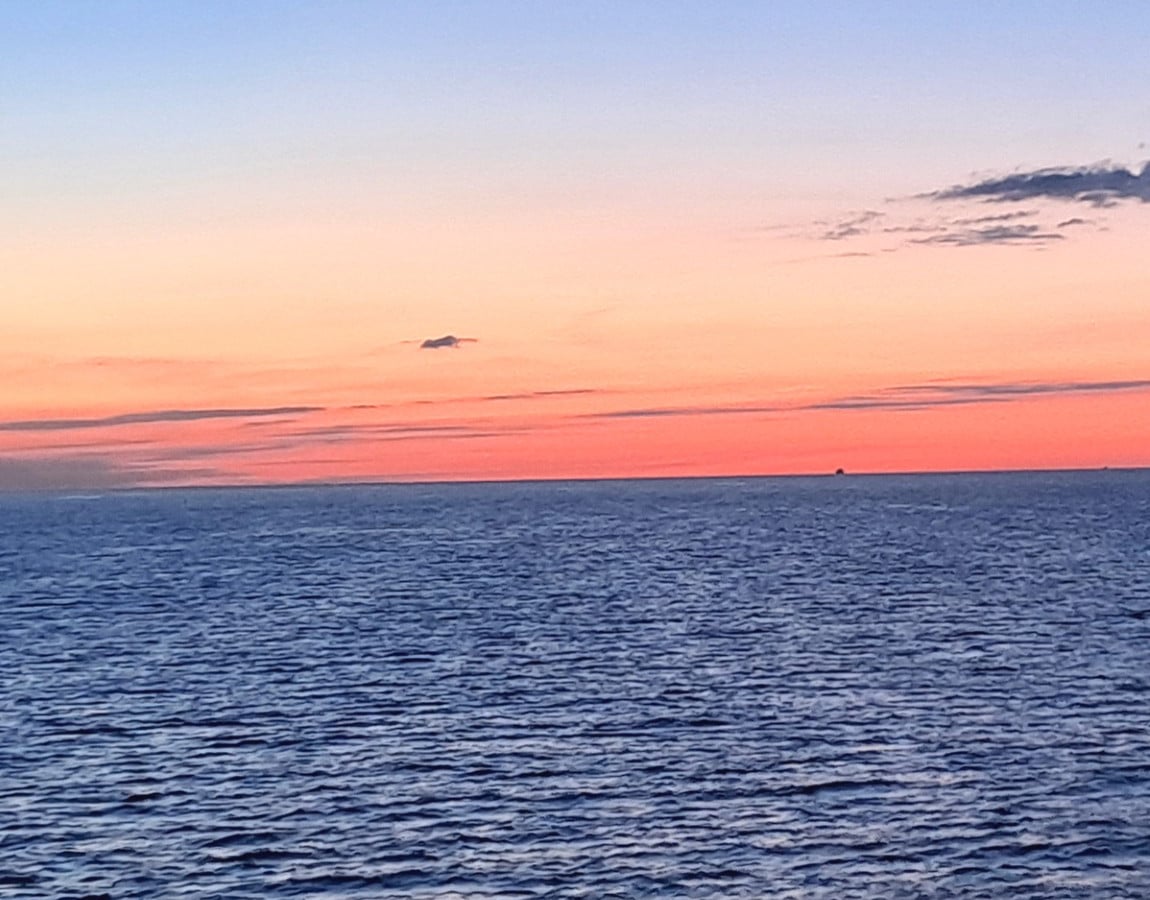
The Saltmere survey notes its submerged seamounts as too deep to break the surface at any tide — five words of boilerplate that quietly carry the whole subject. A shoreless world still has tides. What it does not have is anywhere to watch them from.
A Current Needs a Wall
Terran oceanography is the oceanography of basins. Earth's great gyres circle because continents pen them in, and the strongest currents Earth has — the narrow, fast, western-boundary kind — exist because of the wall they run along. Exactly one Terran current is unbounded, the one that circles the southern polar ocean where no land interrupts it, and for most of the discipline's history it was the anomaly in the textbook.
On Saltmere it is the textbook. A world with no landmass has no basins, no boundaries, and therefore no boundary currents: circulation goes zonal, in belt currents that circle the entire planet and answer only to rotation, wind stress, and the density structure of the water column. Every current on Saltmere is the circumpolar kind. Nothing narrow and fast can form, because there is nothing for it to form against — the anomaly of one ocean is the whole regime of another, which is the weather doctrine below the waterline: same physics, different numbers, and in this case a different topology.
For a platform civilisation the consequence is practical before it is scientific. A belt current is a road, a heat pipe, and a sanitation system — it carries traffic, moves warmth poleward, and takes a city's outfall somewhere else — and it loads a mooring in one steady direction, where the tide loads it in a cycle. Four centuries of Saltmere's continuous mooring engineering are, among other things, the longest-running current-meter record on any human world: the towers feel everything the ocean does, and the maintenance logs kept what the founders' lost archive did not.
A Tide Needs a Raiser, and a Shore To Be Seen
Every star raises a tide in its own ocean; a companion, where a world keeps one, adds its own beat on top. Which raisers a given water world answers to is a line in its survey file. What kind of thing the tide is there depends on the coastline — and on a shoreless ocean, that dependency runs to zero in the strangest way.
On Earth the tide is visible because it breaks against edges: it funnels into estuaries, empties harbours, strands boats, runs up Brother Daire's river twice a day, and cuts Carraig Bán off from the mainland on a schedule a child can learn. The shoreline is where the tide becomes an event. Remove the shoreline and the tide does not stop — it becomes a smooth planetary heave, a change of sea level with nothing to measure itself against, imperceptible to anyone standing on a floating platform that rises and falls with it. Nobody on Saltmere has ever seen the tide. The moorings have never once stopped feeling it, and the tension logs are the tide gauge.
The inversion is worth stating, because it reverses one of the oldest facts in human science. On Earth, the shore taught people that the sky moves the sea before anyone could write the idea down. On a shoreless world the same truth is available only through instruments — Saltmere's founders knew their star moved their ocean because their telemetry told them, and by no other route. Meanwhile the settlement's social tide is artificial: residents plan around the platform cycle the way a tidal-coast settlement elsewhere might plan around actual tides — the record's own phrasing — docking at cycle midpoint, staying off the gantries at its edge. Where the sea declines to supply a rhythm a body can feel, the engineering supplies one, and the culture sets its clock by the machinery.
Thalassa carries the theme forward as inheritance. New Venice's founders brought Venice's answer to water — two millennia of tide fought from behind barriers, ended by a foundation that no longer cared what the water did — to a world where there was never a barrier to abandon. The lagoon heritage arrived on a planet whose tide cannot flood a piazza, strand a boat, or be watched from a window, and the two cities' standing argument about how much of that heritage still means anything is, in part, an argument about tides.
Where the Water Meets Stone Again
The Kingdom of the Five Islands is the counter-case: a water world with shores, and the record's best evidence of what a coastline does to a culture. The archipelago's tides arrive off a planetary storm ocean, break against the caldera rim's sheltered water, and meet terraces, harbours, and an order that named itself facing them. The Tideward Sisterhood's instruction to novices puts the coastal tide's oldest lesson in one breath: "The tide does not come because you called it. It has never once come because you called it, and it has never once failed to come."
The record has nothing to reconcile there, and says so. Tides are the most computable large motion in nature — predictable centuries ahead, on arithmetic every realm runs on its own constants — and aimed at no one; the Abbess's teaching and the tide tables describe the same unanswering regularity in different registers. On the one subject of tides, the devotional reading and the mechanical one walk in step, which the reconciliation desk has been known to cite, a little wistfully, as what agreement would look like if it happened more often.
See also: Weather on Other Worlds, Saltmere, Thalassa, Venice, The Kingdom of the Five Islands, What Prayer Is For.
Discussion
Show discussion
Comments are read after they are posted and anything unsuitable is removed. Posting needs a GitHub account; reading needs nothing.